

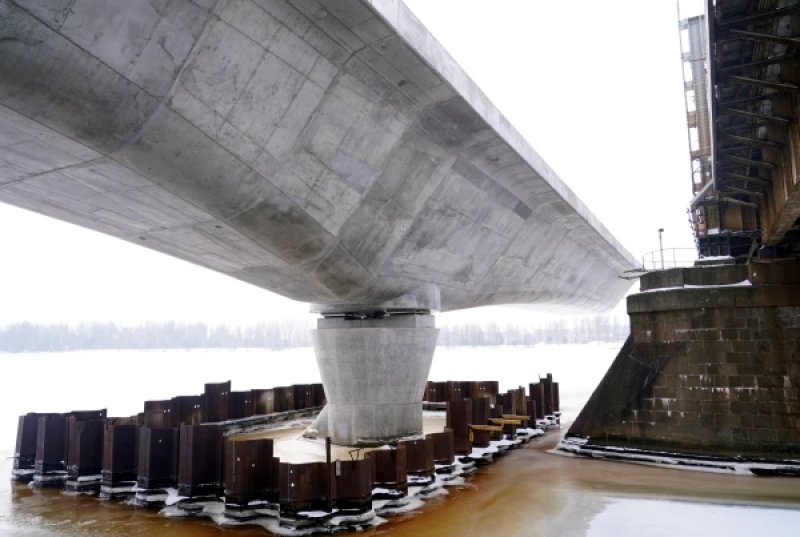
Under the guidance of the ministry, work continues in the technical working group, so a final decision on the construction of a combined bridge has not yet been made. Together with other stakeholders, the ministry is evaluating possible solutions, including already completed design work and technical possibilities for construction. The ministry explains that the construction of the combined bridge is included in the scope of the contract for the main construction works of the "Rail Baltica" project, so the working group is consulting with the main route contractor — "E.R.B. Rail JV" — on the methodology for constructing the bridge, the phased execution of works, and the associated costs. In response to the question of whether the funding of 50 million euros from the Military Mobility Fund allocated for the construction of the bridge supports could be lost, the ministry clarified that the eligibility period for funding lasts until mid-2027. Negotiations are underway with the European Commission about the possibility of reallocating funds to another activity within the framework of the bridge project. The final decision of the technical working group is expected in the first quarter of 2026. Based on this, the Ministry of Transport will prepare and present an informational report to the Cabinet of Ministers on the construction of the combined bridge over the Daugava in Salaspils. As previously reported by the "de facto" program of Latvian Television, the use of the 50 million euros allocated by the Military Mobility Fund is under threat. The program indicated that in the third stage of selection, the fund supported three Latvian projects — the completed bridge over the Salaca and the reconstruction of the platform at the airport, but there are concerns about the feasibility of constructing supports for the planned two-level road and railway bridge over the Daugava as part of "Rail Baltica". According to the program, 51 million euros were allocated for the construction of supports — the largest amount among all projects. However, there are fears that the bridge, as planned, will be too expensive — its construction could cost around 800 million euros. It may be necessary to return the money or attempt to redirect it to the construction of a different type of bridge. Additionally, the optimization of technical solutions for the main route towards the border with Lithuania may only be completed in 2026, meaning that construction of embankments and overpasses will not begin before that time. According to "de facto" information, calculations indicate that the combined two-level bridge will cost nearly 800 million euros, and such funds are unlikely to be found. In the spring of last year, the company "RB Rail" proposed reducing the size of the bridge, including abandoning the road component. This was opposed by the company "Latvijas valsts ceļi" (LVC), as there is physically no more space for a separate road bridge in the originally designated corridor for the Riga bypass road. LVC representative Anna Kononova explained that their need is for a structure that ensures the movement of road transport. However, LVC was not involved in the initial phase of studying the combined solution and did not participate in the decision-making about its configuration. The decision to build such a combined bridge was made in 2021. It was justified by the fact that two separate bridges would cost 40 million euros more than the two-level bridge, which could have been built for 200 million euros at 2020 prices. It was noted that such a bridge would become one of the most complex construction projects in the Baltic States and would have only three analogues in all of Europe. As previously reported, according to the Baltic States joint venture "RB Rail", the costs for the first phase of "Rail Baltica" could reach 14.3 billion euros, of which 5.5 billion is in Latvia. At the same time, through the optimization of technical solutions, savings of up to 500 million euros are possible, and other cost reductions are not excluded. The total project costs, according to the cost-benefit analysis, in the Baltics could reach 23.8 billion euros. In the previous analysis in 2017, the total cost of the project was estimated at 5.8 billion euros. The "Rail Baltica" project involves the construction of a European standard gauge railway line (1435 mm) from Tallinn to the border with Lithuania and Poland, to connect the Baltic States with the rest of Europe. Within the framework of the project, 870 km of new line will be built in the Baltic States, allowing trains to travel at speeds of up to 240 km/h.