

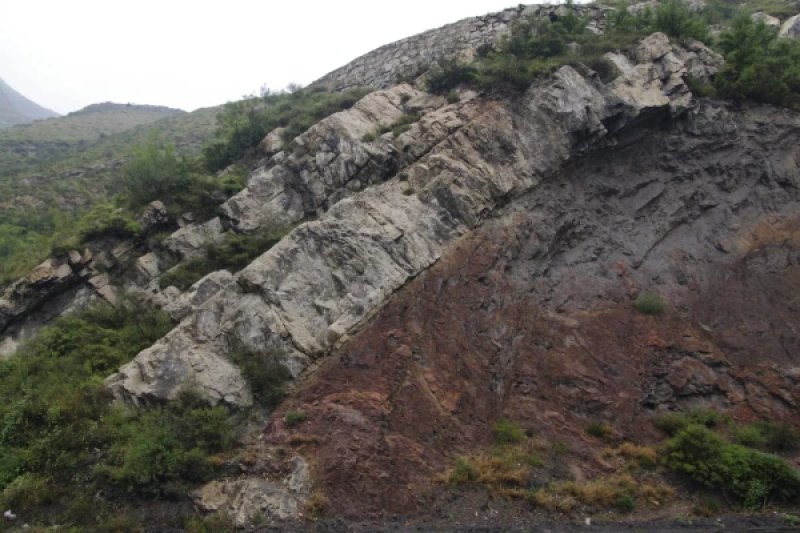
The Great Unconformity is observed worldwide, where sedimentary rocks aged about 500 million years lie directly on top of much older rocks, often exceeding 1.7 billion years in age. The missing layers may represent a period ranging from several million to over a billion years, making this phenomenon the most mysterious gap in Earth's geological record. The study is published in the Proceedings of the National Academy of Sciences, reports [Focus](https://focus.ua/technologies/745023-v-istorii-zemli-tainstvennym-obrazom-otsutstvuet-milliard-let-teper-uchenye-znayut-pochemu) citing 404media. Now, scientists have presented new evidence that this geological gap was largely created by tectonic processes occurring from 2.1 to 1.6 billion years ago, during the Neoproterozoic era, when the ancient supercontinent known as Columbia was forming. Their results, based on geological data from China, challenge an alternative explanation suggesting that the gap formed as a result of a period on Earth known as "Snowball Earth," a widespread glaciation that occurred much later, around 700–600 million years ago. This "Snowball Earth" period existed before the Cambrian explosion, which is the sudden emergence of complex life on Earth around 530 million years ago, resulting in the formation of major animal families, leading to theories about a connection between these two events. The new study with revised timelines of tectonic processes questions this connection. According to the scientists, the exhumation of metamorphic/igneous rocks in the central part of the Earth's crust in China primarily occurred between 2.1 and 1.6 billion years ago, and the timing of exhumation varies from one continent to another. The Great Unconformity in North America was shaped by specific regional factors, such as the breakup of the supercontinent Rodinia. The Great Unconformity is perhaps best known as a visible feature of the Grand Canyon in the United States, where the core of the ancient continent of Laurentia is preserved. But it is also present in the remnants of other ancient continents, such as Baltica and Amazonia. "This is an astonishing case of stratigraphic amnesia, where the Earth seems to have erased entire epochs of geological time from its memory," the scientists say. To clarify the origin of the Great Unconformity, the scientists studied the thermal history of rocks at five locations in northern China. The results showed that in this region, the exhumation of the crust (the process by which buried rocks are pushed to the Earth's surface) was primarily driven by tectonic processes in the ancient Neoproterozoic era. "It is best to view the Great Unconformity as a compilation of everything that could have happened over a period of time that, in this particular case, exceeds a billion years," the scientists say. Although the new study sheds light on the origin of the Great Unconformity and its regional variability, many unresolved questions remain regarding this geological gap.