

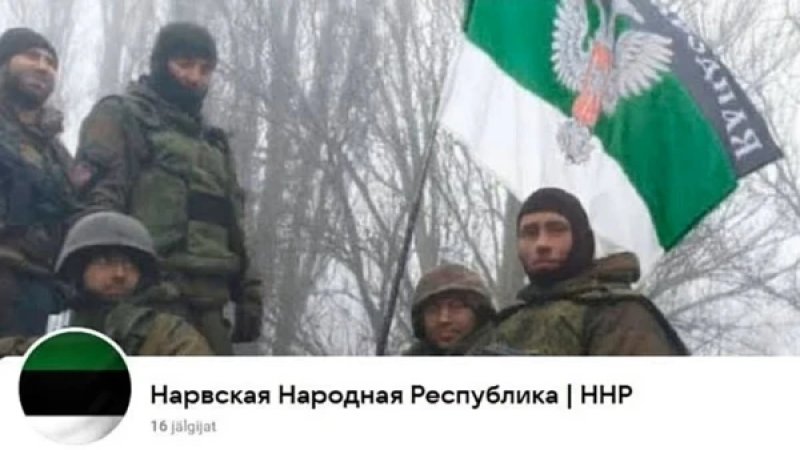
A flag, its own coat of arms, newly drawn borders - and rhetoric strongly reminiscent of the proclamation of the so-called 'people's republics' in Donbas in eastern Ukraine and the annexation of Crimea in 2014: on social media, the third largest city in Estonia, Narva, has suddenly begun to be referred to as the 'Narva People's Republic'. According to a study by the Estonian anti-propaganda platform Propastop, the social media campaign is based on an alleged separatist project aimed at detaching the Russian-speaking northeastern part of Estonia - right on the border with Russia. ## ## "Are You Scared?" The most notable Telegram channel to date called 'Narva Republic' was created on July 14 of last year. It currently has over 700 subscribers. However, active posts have only been made since February 18, 2026. In addition to calls for armed resistance and sabotage, a narrative about the discriminated Russian minority is promoted, along with fears of an Estonian invasion of Russia. An article from February 19 quotes the Estonian Minister of Foreign Affairs: "The Estonian army will cross the border and bring the war to Russian territory if the Russian army invades Estonia." The article ended with the question: "Are you scared?" However, the quote from Margus Tsahkna is taken out of context. In an interview with the British newspaper Telegraph, he stated that in the event of a Russian attack on the Baltic states, they would "bring the war to Russian territory and strike at the interior regions." However, there is no mention in the interview of a preemptive invasion. Another Telegram post states that the separatists "advocate for autonomy," which, if refused, will escalate into "a full-scale armed conflict and the creation of an independent state within the borders of Ida-Viru County." Ida-Viru County is an area located on the eastern border with Russia. ## Memes Designed to Make You Nervous However, military expert Carlo Masala does not see an acute threat, although the campaign should not be taken lightly. According to him, this is "all part of a psychological warfare campaign." Masala does not believe that Russia is opening a second front in its aggressive war against Ukraine, so he does not see signs of an immediate attack on Narva. Nevertheless, these actions "should not be taken lightly," Masala believes. Rather, the mix of memes, provocative jokes, and propaganda elements is part of "Russia's psychological warfare campaign," Masala argues. The content is designed to make people "nervous" and "hysterical." The memes Masala refers to include, for example, images of the daily routine of "Narva militia members," which thematize the capture of two Estonian cities - Sillamäe and Kohtla-Järve. The article states, for example, "Wake up at 6:00 AM, then morning hygiene at 7:00 and breakfast at 8:00, after which the storming of Narva begins at 9:00, lunch at 12:00, at 15:00 - Sillamäe, and after lunch - Kohtla-Järve. Sillamäe and Kohtla-Järve at 00:00, then a Burzum concert at 17:00, dinner at 19:30, a concert by Akim Apachev at 20:00, and finally, the day ends with fireworks at 22:00." Akim Apachev is a pro-Russian rapper and propagandist, and the band Burzum has been criticized for its ideological proximity to National Socialism. Maps defining the alleged 'People's Republic' and new borders are also posted on the channel along with green, black, and white flags. ## The So-Called 'Narva People's Republic' The city of Narva is located directly on the border with Russia and is the third largest city in Estonia with a population of 50,000. More than 90 percent of the population are Russian speakers, many of whom have Estonian citizenship. Many of them or their families were resettled here after World War II when the indigenous population was largely displaced after the arrival of the Red Army in 1944. When Euronews was in Estonia in 2022, residents told us that they do not face discrimination because of their Russian language. Nevertheless, Moscow-controlled television channels have for years tried to portray the Russian-speaking minority as victims. In Russian state media, for example, in talk shows like '60 Minutes' on the Rossiya 1 channel, there are regular discussions about "manipulations with criminal cases against Russian-speaking compatriots" in the Baltic states. ## ## Estonian Intelligence Services Suspect a 'Coordinated Campaign' According to the Estonian Internal Security Service (ISS), there are grounds to believe that this may be a coordinated information campaign. "Such tactics have been used before, both in Estonia and in other countries," said the ISS spokesperson to the Estonian news site Delfi. "It is a simple and cheap way to provoke and intimidate society." The Estonian Internal Security Service also suggests that this is done to sow discord and undermine social cohesion. This aligns with the assessment of military expert Carlo Masala. In his book 'If Russia Wins', published in 2025, he posed a thought experiment. "To what extent will NATO be involved if Estonia is attacked? Will we dare to enter a full-scale conflict against possibly 1.5 million Russian soldiers to liberate a city with a population of 50,000, which is also always on the brink of nuclear war?" Masala questions. ## ## From 'Little Green Men' to the So-Called 'People's Republic' The proclamation of the so-called 'people's republic' is not an unknown narrative. In 2014, pro-Russian separatists, with the support of Russian troops, also proclaimed the so-called 'Luhansk' and 'Donetsk People's Republics' in Donbas. During the annexation of Crimea in the same year, Russia deployed so-called 'little green men' - soldiers without national insignia. The main goal was to demonstrate presence. Several years later, Moscow also justified the large-scale invasion of Ukraine under the pretext of protecting Russian-speaking population groups in these territories. However, there is no evidence that ethnic Russians faced systematic persecution by Ukrainian authorities, let alone a threat of extermination based on national, ethnic, or cultural grounds. This is confirmed by reports from the Council of Europe, the UN High Commissioner for Human Rights, and the OSCE. "The fact that the 'Narva People's Republic' is now emerging lays the groundwork for subsequent propaganda of alleged oppression and the necessary support from Moscow and actors in our country to continue spreading this narrative," writes political scientist Niko Lange in an article on the X platform. According to him, "propaganda must be exposed, influence networks must be fought, and Russian secret services must be thrown out." The topic of the 'Narva People's Republic' lives its own life in foreign media. TALLINN, March 21, BNS - According to the chairman of the Foreign Affairs Committee of the Riigikogu, Marko Mihkelson, the topic of the so-called 'Narva People's Republic' has made its way into international media and attracted some attention. "Unfortunately, the topic of the 'Narva People's Republic' lives its own life in international media," Mihkelson wrote on social media after giving two interviews on the subject. "I shared what we know at the moment," said Mihkelson, referring to an interview with the Polish television channel Belsat. "There is a high probability that a very small number of people, possibly even one person, is behind this entire virtual information operation. The available information indicates that this person or persons are acting from the territory of Russia. A connection to a larger information operation receiving instructions from the Kremlin seems unlikely." "Surveys of Narva residents conducted with the assistance of Delfi for the television program gave a 100 percent unanimous response: they do not want to hear anything about this 'people's republic' because they live well and safely in Estonia," Mihkelson added.
