

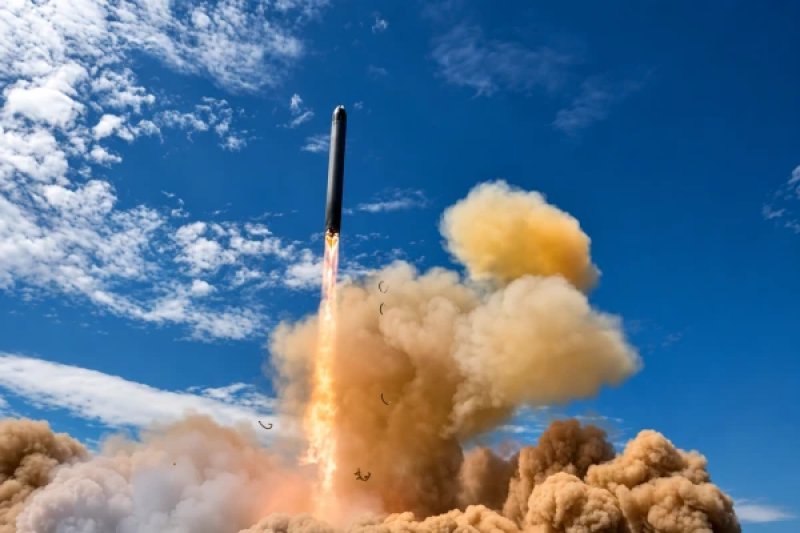
Russia conducted another test of the intercontinental ballistic missile 'Sarmat'. The launch took place against the backdrop of the ongoing modernization of Russian nuclear forces and statements by Vladimir Putin that the war in Ukraine is nearing its end. The President of Russia called the 'Sarmat' "the most powerful missile in the world" and stated that the total power of its warheads significantly exceeds that of Western weapon systems. "This is the most powerful missile in the world," emphasized Putin. The missile is set to replace the Soviet 'Voivoda' complex. In NATO classification, the system is known as 'Satan II'. According to Russian authorities, the 'Sarmat' is capable of hitting targets at ultra-long distances and carrying multiple nuclear warheads. It is claimed that the missile can travel at speeds exceeding 35,000 km/h on suborbital trajectories, which theoretically complicates its interception by missile defense systems. The development of the complex began back in 2011, but the program has faced difficulties multiple times. Prior to the current launch, only one successful test had been publicly reported. In 2024, media reported a possible accident during tests at the Plesetsk cosmodrome, where satellite images captured a large crater after an explosion. The 'Sarmat' belongs to heavy intercontinental ballistic missiles and, according to analysts' estimates, can carry a payload of up to 10 tons. The test took place shortly after the Victory Parade in Moscow. This year, observers noted that for the first time in many years, heavy military equipment hardly passed through Red Square. In recent years, Russia has been actively updating its nuclear triad — land-based missiles, strategic submarines, and bombers. After the onset of full-scale war in Ukraine, Moscow accelerated the modernization of its weapons and regularly emphasizes the importance of the country's nuclear potential. In addition to the 'Sarmat', Russia is developing other strategic systems, including the hypersonic complex 'Avangard' and the medium-range missile 'Oreshnik'. The test also occurred amid rising tensions over nuclear arms control. In February, the last treaty between Russia and the U.S. that limited the strategic nuclear arsenals of both countries expired. According to the Federation of American Scientists, Russia has approximately 3,700 nuclear warheads, while the U.S. has about 4,300. After the expiration of the treaty, there are no formal restrictions on deployed strategic nuclear weapons, which has heightened concerns about a new arms race. Putin stated that the development of new Russian systems was a response to American missile defense programs. "We were forced to think about ensuring our strategic security in the context of a new reality," he said. The test of the 'Sarmat' demonstrates that nuclear modernization remains one of the key directions of Russian military strategy amid growing international tensions.