

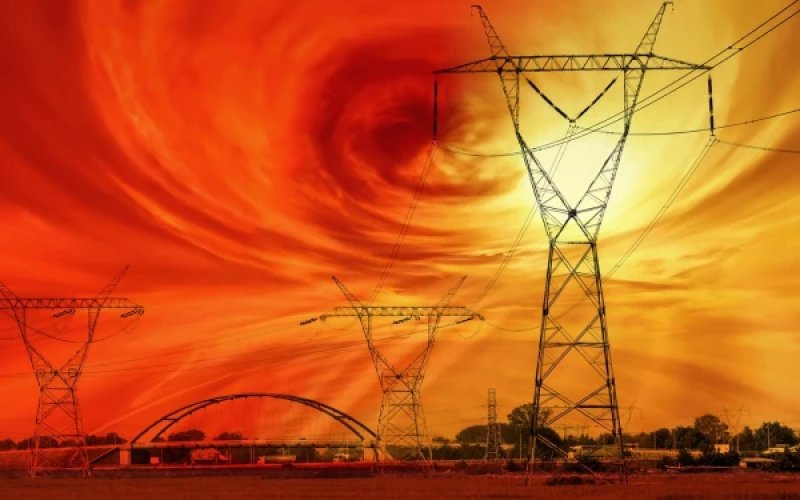
A group of scientists from Boston University has proposed that humanity discuss the costs of the StormWall project – a special plasma shield that is intended to block energy flows from the Sun when the next geomagnetic storm occurs. More specifically, a "superstorm," an example of which is the Carrington event of 1859. According to calculations, such phenomena are expected to occur approximately once a century, so there is already a "schedule delay," and the likelihood of a new impact is increasing each year. It all comes down to money. In 2024, a powerful solar storm disrupted the operation of GPS systems used for precise tractor control. Farmers in the U.S. lost $500 million in that instance. But even earlier, in 2021, IT scientist Sangita Abdu Jyoti from the University of California, Irvine calculated that a geomagnetic superstorm would cause damage amounting to $7 billion per day. And that’s just for the U.S.; globally, the losses could reach $2.4 trillion. As the infrastructure vulnerable to such impacts grows, humanity can no longer afford to "weather it out" – ways to protect against solar activity must be sought. The StormWall project involves launching six special space tankers loaded with alkaline chemical elements, such as barium or lithium, to the boundary of the planet’s magnetic field. Under the influence of solar radiation, they will lose electrons, leading to the formation of a plasma cloud. Most of the energy from the geomagnetic storm will be used to create this plasma shield – it just needs to be calculated correctly how to disperse the substance in the path of the radiation. The main difficulty is that such a shield is short-lived; the magnetosphere will disperse the substance in just 6 hours. This is literally a one-time solution, and a very expensive one, as it will require launching six massive rockets simultaneously to carry a very heavy payload into space. They will need to be prepared in advance, after which they could stand by for decades awaiting that geomagnetic superstorm. All of this promises colossal costs, which is why the project is up for discussion.