

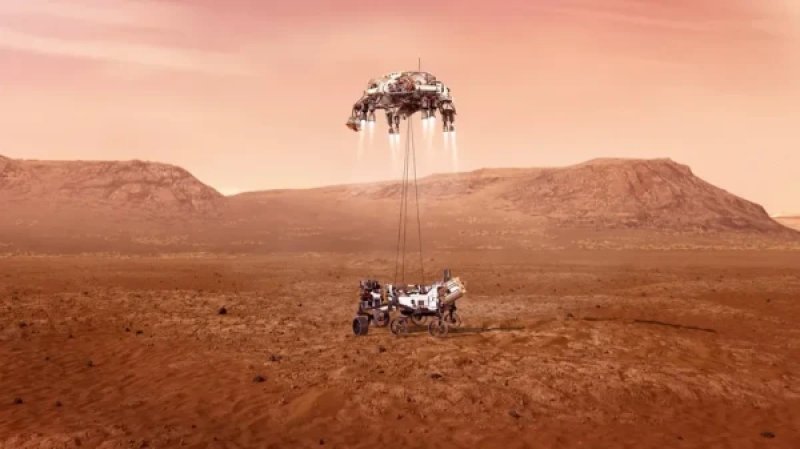
NASA's Perseverance rover has discovered complex organic carbon compounds in Martian rocks, marking another significant finding in the search for traces of ancient life on the Red Planet, writes Interesting Engineering. Researchers identified large carbon-containing molecules in two samples of mudstone collected from the Jezero crater—a region believed to have hosted a lake billions of years ago. Scientists call this one of the most compelling pieces of evidence for the presence of organic material ever found in this crater. This is why NASA chose Jezero as the rover's landing site: scientists hypothesized that signs of a habitable environment might have been preserved here in the distant past. At the same time, researchers emphasize that this new discovery does not prove the existence of life on Mars. However, the presence of complex carbon compounds in sedimentary rocks significantly strengthens the case for further investigations. ### Carbon-Rich Martian Rocks A team of scientists led by Ashley Murphy from the Planetary Science Institute analyzed data obtained using the SHERLOC instrument aboard Perseverance. This instrument uses laser spectroscopy to determine the chemical composition and minerals in rocks. SHERLOC created detailed maps of organic substances in the mudstones and detected hundreds of signals associated with high carbon content. According to Murphy, macromolecular carbon is of particular interest to scientists—on Earth, such compounds are often found in very ancient rocks and can preserve traces of ancient microbial activity. The researcher noted that if early Mars had conditions similar to those on young Earth, then similar organic compounds could also be expected in its ancient rocks. The detection of such substances helps establish whether the ingredients and conditions necessary for the emergence of life existed beyond Earth. On Mars, carbon-containing material has been found in the mudstones of the Bright Angel area, which is associated with the ancient riverbed of Neretva Vallis. This river once carried water to the Jezero crater. ### Connection to Previous Discovery The new finding comes less than a year after Perseverance explored a rock called Cheyava Falls. Scientists labeled it one of the most interesting samples ever collected on Mars. Inside the sedimentary rock, researchers discovered unusual structures informally dubbed "leopard spots." Such formations can arise from various geological processes. Some of them require extremely high temperatures or very acidic environments. However, scientists do not believe that such conditions existed at the site of this rock's formation. At the same time, similar structures can also form as a result of biological activity, making the sample particularly promising for further studies. Although the origin of these formations remains unknown, many researchers consider Cheyava Falls one of the most likely candidates for a potential biosignature sample among all those found on Mars. The discovery of a large amount of organic carbon in neighboring rocks only enhances the scientific value of this region. ### Signs of Broader Distribution of Organics This discovery may indicate that organic compounds were widespread across a significantly larger area of ancient Mars. According to researchers, Perseverance has recorded macromolecular carbon directly on the natural surface of Martian rock for the first time. Furthermore, this is the first instance of detecting this type of carbon in mudstones outside Gale Crater, which continues to be studied by another NASA rover—Curiosity. Kyle Ackert, the deputy principal investigator of the SHERLOC mission from NASA's Jet Propulsion Laboratory, noted that the discovery could indicate a broad distribution of organic compounds on Mars billions of years ago. Ultimately, scientists hope to return Martian samples to Earth for detailed laboratory analysis. Such studies will help determine whether the detected carbon compounds resulted from ordinary geological processes or if they preserve traces of a much more intriguing chapter in Mars' history—the possible existence of life.