

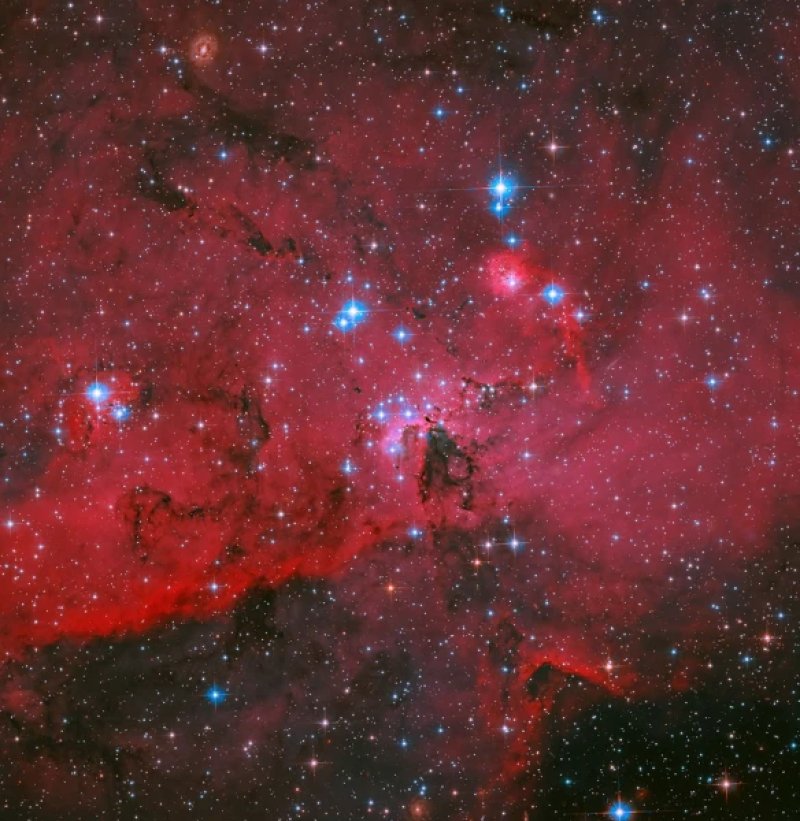
NASA has released a new image captured by the Hubble Space Telescope. The photo depicts the region LH 95 in the Large Magellanic Cloud—a dwarf galaxy that is a satellite of the Milky Way. In the photograph, blue and white young stars stand out brightly against the backdrop of a crimson glowing cloud of hydrogen. NASA compared this landscape to fireworks bursting amid clouds of smoke. LH 95 is considered one of the largest stellar nurseries in the Large Magellanic Cloud. Here, both young low-mass stars and massive blue giants coexist. It is the heaviest stars in the region that shape the surrounding space. Their powerful ultraviolet radiation and stellar winds heat the hydrogen clouds, causing the gas to glow. The dark streaks in the image are dense dust clouds that are still resisting the effects of radiation. The colors in the image reflect different wavelengths of light recorded by the telescope. The crimson glow is produced by hydrogen-alpha radiation—one of the main indicators of active star formation. Thanks to these observations, astronomers were able to study about 2,500 young stars that have nearly reached their mass but have not yet begun nuclear fusion in their cores. Such objects are referred to as pre-main-sequence stars. The study showed that young stars continue to accumulate material from the surrounding gas and dust disks for several million years—longer than some models had suggested. This allows for a better understanding of the star formation process and the evolution of their protoplanetary disks. Scientists also discovered that LH 95 simultaneously hosts stars of different generations. This indicates that star formation here did not occur as a result of a single event but has continued over a long period. The most massive star in this region is about 60–70 times heavier than the Sun and is estimated to be about a million years younger than most of its neighbors. Such giants have relatively short lifespans and end their evolution with powerful supernova explosions. Astronomers consider LH 95 one of the most interesting areas for studying star birth. Due to the relatively small amount of cosmic dust, it is easier to observe processes that are often hidden from telescopes in similar regions of the Milky Way. The Hubble Space Telescope has been operating in orbit for over three decades. Today, its observations are complemented by data from the James Webb Telescope, and in the coming years, it will be joined by the new Nancy Grace Roman Space Telescope. The new image from Hubble not only impresses with its beauty but also helps scientists gain a clearer understanding of how new stars are born in the universe.