

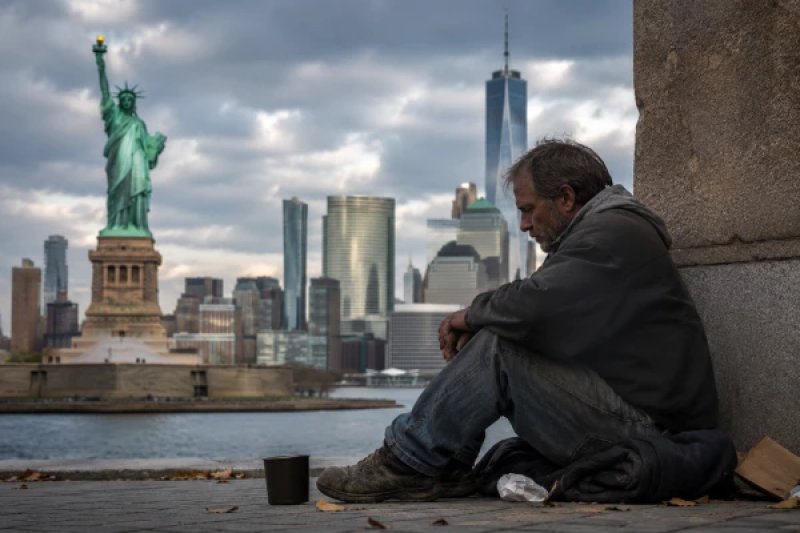
> "Talent is evenly distributed in our country. Opportunity is not," says Patrick Sally, a representative of the United Way charity in Kansas City. According to him, even neighboring areas can differ drastically in income levels, life expectancy, and life prospects. > "Many families are balancing on a thin line. One unexpected bill is enough to throw their entire life off course," he notes. ### The American Dream is Not Accessible to Everyone The small town of Raymore in Missouri is considered typical for America. But even here, the gap between affluent and low-income residents is quite noticeable. Single mother Briana Watson, who is raising two children, knows well how difficult it is to make ends meet. > "We all fall," she hums, twirling around the almost empty living room with her two-year-old daughter. According to her, this is how she would describe her entire life — constant falls and attempts to get back up. Briana moved into a new apartment just a month ago, but she still has almost no furniture. "I didn’t have any in my previous place either," the woman admits. She works from home for an auto glass repair company and earns a decent salary, but it is still not enough. > "I received so many warnings about utility shutoffs that it’s embarrassing to talk about. I am literally living on the edge of financial ruin," the American shares.  ### There Are Jobs, But No Money According to the U.S. government, in 2024, 10.6% of American families were living below the official poverty line. However, experts note that the calculation method has hardly changed for decades and does not reflect the real situation. As a result, millions of working Americans are not formally considered poor, even though they struggle to pay for the most essential expenses. According to United Way estimates, this concerns 35–40% of all households — nearly 55 million families. > "A hospital bill or car repair can lead someone to stop being able to afford housing," explains Patrick Sally. ### Wage Growth is Not Keeping Up with Price Increases Donald Trump claims that Americans are earning more today than ever before. > "Many do not understand that we are currently experiencing a golden age. I’m not just talking about the rich — ordinary people are also earning record incomes," the president stated ahead of the 250th anniversary of the United States. Economists acknowledge that wages have indeed increased, but inflation in recent years, the COVID-19 pandemic, the war in Ukraine, and the conflict surrounding Iran have significantly raised the cost of living. > "People have to choose daily: buy medicine or food. Inflation continues to seriously complicate life," says Sally. ### One Step Away from Poverty This is confirmed by Chris Myers, who previously owned his own microbrewery. After closing his business, he and his wife took government jobs. > "The average American today is much closer to poverty than to wealth," he believes. According to him, expenses are rising faster than incomes, and Congress even refused to raise federal employees' salaries next year. > "We are not starving, but with the money we earn, we could live much better," says Myers. ### The Middle Class is Shrinking Over the past few decades, the American middle class has noticeably decreased. While in 1971, 61% of the population belonged to it, today it is about 51%. At the same time, the share of both low-income and the wealthiest citizens has increased. According to a Pew Research study, six out of ten Americans believe that the best times for the country are already behind. Meanwhile, 68% of U.S. residents remain optimistic and hope for the better. A Gallup poll also shows that more than three-quarters of Americans still believe that the "American Dream" is worth striving for. For Chris Myers, this dream looks quite simple. > "I dream of less poverty and hunger. I would like to see more fairness — not a situation where one person like Elon Musk has a colossal fortune while millions struggle to pay for the essentials," he says.
