

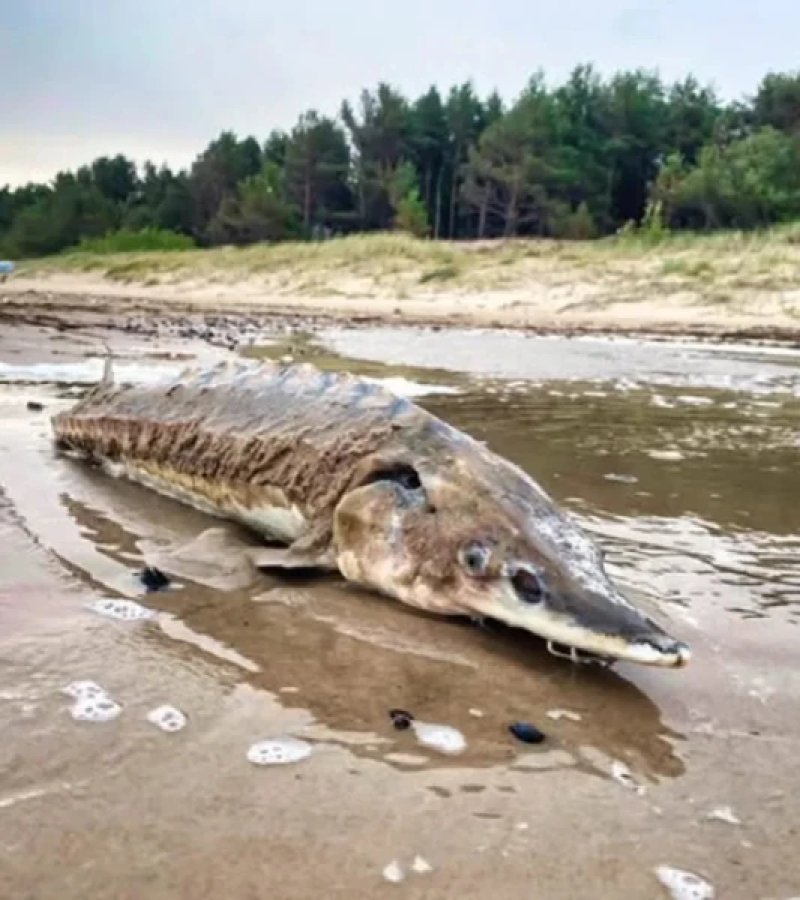
This week, a sturgeon was found washed ashore near the Miķeļbāka campsite on the coast of the Ventspils region. Although this species is officially considered extinct in the Baltic region, experts explain that such encounters are becoming increasingly common thanks to an international program aimed at restoring the population. As Ivars Putnis, head of the fish resources research department at the Bior Institute, explained, since Latvia joined the restoration program for the Baltic sturgeon in 2013, cases of catching these fish have been regularly recorded. Only this year, there have already been 13 recorded cases of sturgeon catches in the coastal industrial fishing journal. Most of these occurred off the coast of the Ventspils region. According to the expert, sturgeon was once a common and important fish for the region, but over time it completely disappeared from the Baltic Sea. One of the last recorded catches of wild Baltic sturgeon was in the 1990s off the coast of Estonia. Germany was the first to begin restoring the population in the early 2000s, and later other countries in the region joined the program. In Latvia, it has been in operation since 2013. As part of the project, sturgeons that are genetically as close as possible to the historical Baltic population are raised in fish farms, after which the young fish are released into rivers and their estuaries. This is why specialists are increasingly receiving reports of encounters with these fish. According to Putnis, the found sturgeon is not something exceptional. Scientists expect that in the coming years, fishermen will encounter sturgeons even more frequently. Everyone who discovers such a fish is asked to report it to the Bior Institute. It is especially important to check if there is a special tag with a country code and phone number near the dorsal fin — such tags are often attached to fish released as part of the restoration program. Such reports help scientists track migration routes, growth rates of sturgeons, and assess the effectiveness of the program. In recent years, about three thousand young sturgeons have been released into Latvia's water bodies. The release is not conducted annually, but the program itself continues. Sturgeon are considered slow-growing species. They can reach sexual maturity at seven to eight years, but often begin to spawn only at ages 20 to 30. So far, scientists do not have confirmed data that at least one of the fish released under the program has already spawned in the wild. Experts hope that over time the population will be able to restore itself. However, success cannot be guaranteed: the climate is changing, many spawning rivers remain inaccessible due to hydrotechnical structures, and the species has already once disappeared from the Baltic Sea. Additionally, sturgeons are widely farmed in aquaculture, so individual specimens may escape into the wild from private farms. From just a photograph of the fish found near Miķeļbāka, specialists cannot determine whether it was released under the state program or escaped from a fish farm. The Bior Institute maintains a database of rare fish species. Besides sturgeons, other unusual visitors occasionally appear in the Baltic Sea. For example, off the coast of Liepāja, swordfish washed ashore have been found several times, having come from the Atlantic Ocean. Experts emphasize that every sturgeon finding has scientific value. If you manage to see or catch such a fish, it should not be ignored — the information can help assess whether it will be possible to return a species to the Baltic Sea that was recently considered irretrievably lost.