

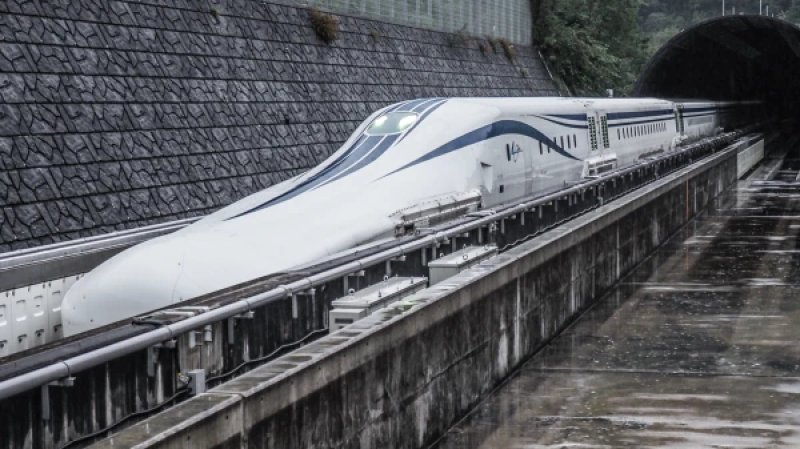
 Foto: BB.LV / Маглев
Maglev (magnetic levitation) is a high-speed train that is suspended in the air, moves, and is controlled by the force of electromagnets. Due to the absence of contact with the tracks, it experiences no friction, allowing it to reach enormous speeds with minimal noise and vibration. Maglev trains in Japan will operate at speeds of up to 500 km/h. Travel time between Shinagawa Station in Tokyo and Nagoya will be reduced from the current approximately 90 minutes to 40 minutes, while the journey between Tokyo and Osaka will be cut from 2 hours and 20 minutes to 67 minutes. The Japanese government views the new line as the foundation for creating a so-called mega-region that unites the agglomerations of Tokyo, Nagoya, Osaka, and Kyoto. The combined population of these regions is about 66 million people, and the gross regional product is 330 trillion yen (approximately $2.04 trillion), which exceeds half of the country's economy. In addition to its economic impact, maglev is expected to enhance the country's transportation resilience, serving as a backup route in case of large-scale natural disasters that could incapacitate the existing Tokaido Shinkansen high-speed rail line. However, the implementation of the project has been repeatedly delayed. The former governor of Shizuoka opposed the construction due to concerns about its impact on the Oi River. Additionally, in Gifu Prefecture, groundwater levels decreased after the tunnel was dug, causing work to be suspended since 2024. In 2024, the project operator Central Japan Railway (JR Central) abandoned plans to open the Tokyo-Nagoya section in 2027. Amid rising labor and construction material costs, the budget for this phase doubled to 11 trillion yen (approximately $75.9 billion). After receiving permission from Shizuoka, the governors of Osaka, Mie, and Nara prefectures called for the construction of the Nagoya-Osaka section to begin in parallel with the completion of the first phase, in order to open the entire line as quickly as possible. The governor of Osaka stated that creating a major economic corridor between Tokyo and Osaka is important for Japan's economic growth and requires government support. According to Nikkei, there is already an increase in land prices in the areas around the future stations. Furthermore, authorities expect that the new line will stimulate tourism development, making regions outside the traditional Tokyo-Kyoto-Osaka route more accessible.
