

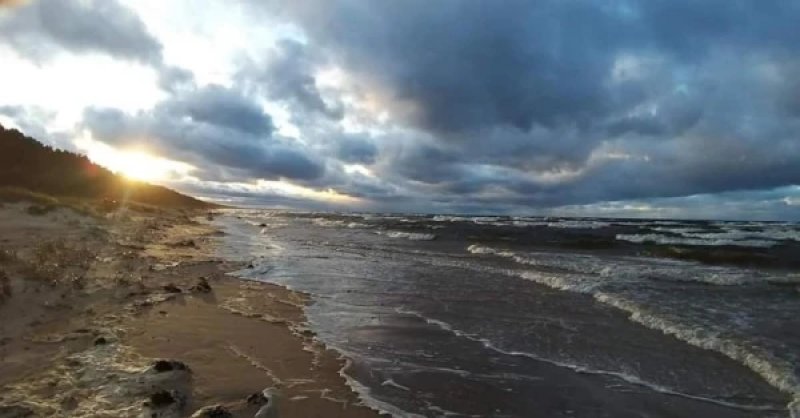
Tvak, a woman, recounted that she experienced one of the most frightening moments of her life. "The sea was warm, like fresh milk. But today, for the second time in my life, I felt what big waves and the force that pulls you into the sea are like. The first time I was 13 years old — then my brother pulled me out. I had no strength left to fight. And today, even sitting right by the shore, I felt how the waves were pulling me in with tremendous force. And in Carnikava, deep holes have formed now. Be careful!" — wrote Liva. Under the post, dozens of people admitted that they also faced unusually strong currents. One woman shared that she felt similar sensations in Saulkrasti. "Jumping on the waves, I felt for the first time that unpleasant feeling when you are pulled in and back. It was very scary. The water was warm, like milk." Another user recalled a similar incident in Liepaja. "It was truly terrifying. I was pulled in almost instantly!" However, there were those who believe that big waves are not dangerous in themselves if caution is observed. However, the author of the post clarified that her warning is not about the waves at all. "I know what big waves are, and I even know what the ocean is like. But right now, it’s about something else — about deep holes and the force with which the water pulls you into the sea. It’s better to warn people once too often than to learn about a new tragedy later. Especially since just two weeks ago, a young man died here." Users urge vacationers to be especially attentive, not to overestimate their strength, not to let children into the water without supervision, and to remember that even at a familiar beach, the state of the sea can change literally in a few hours. The topic of children's safety at the beach sparked particularly lively discussion. Many admitted they were shocked by how carelessly some adults treat what is happening. One woman recounted seeing small children whose parents let them into the sea almost unsupervised. "My daughter and I were splashing right by the shore, but nearby were parents who let their children with inflatable rings go beyond the second sandbar. It was simply irresponsible." Another vacationer shared a story that made her intervene. "While my children were near me, I noticed a girl about five or seven years old who was quite far from the shore. The parents were sunbathing calmly. I called them several times, but they did not respond. So I approached myself, and only after that did the father finally enter the water to the child." Many participants in the discussion emphasized that adults cannot relax for even a minute near the water. "There is no rest for parents by the water. You need to stand next to the child in the water." ## ## Actions if you are pulled by a current In Latvia, such currents are often found in the area of the Riga Gulf and the Baltic Sea — especially during or immediately after a storm, as well as near sandy shallows and bars. Water pushed to the shore by the wind suddenly retreats, creating a powerful narrow corridor directed straight from the shore into the sea at speeds of up to 15-20 km/h. Latvian rescue services (VUGD) provide the following clear instructions for such situations: Do not fight the water. Swimming against the current to the shore is pointless, as its speed can exceed that of the swimmer, and you will quickly lose strength. Swim parallel to the shore. The current is rarely wide (usually 10-20 meters). Swim sideways along the beach (parallel to the shore) to exit the narrow corridor of moving water. The current (rip current) is usually narrow (from 3 to 20 meters). Once you swim away from the central flow, the current will stop pulling you into the depth. Conserve your strength: If you cannot swim sideways, swim with the current. Once it weakens (usually after 50-100 meters), swim sideways and return to the shore diagonally or wait for the waves to help you. Do not be afraid to drift. If you are exhausted, roll onto your back, conserve energy, and call for help. Attract attention. If you are struggling, raise your hand and shout to attract the attention of rescuers or people on the beach. Witnesses, call for rescuers. If you witness someone struggling and realize that the swimmer is not managing, immediately call the emergency number 112. Rip currents rarely carry you far into the open sea — usually, they dissipate quickly and fade at a distance of 50–100 meters from the shore, after which it will be easy to swim back to the shore.