

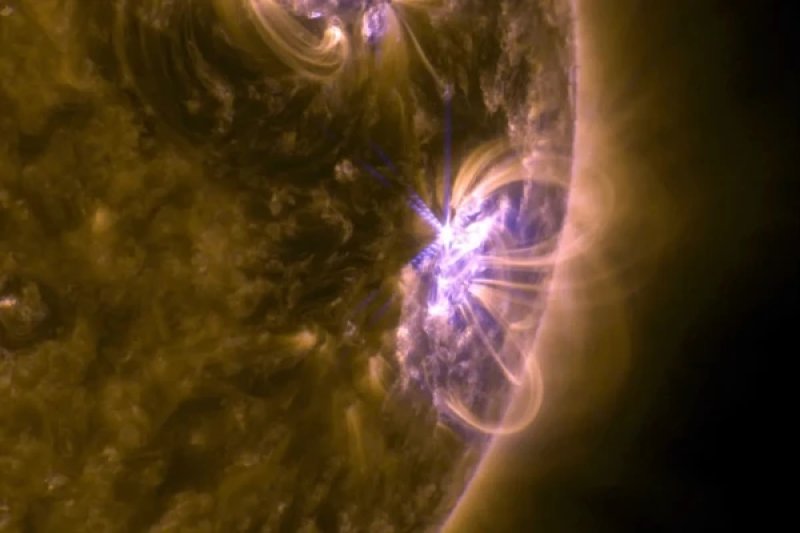
Solar storms capable of disrupting satellites, GPS, power grids, and communication systems may be significantly more powerful than previously thought. This conclusion was reached by researchers led by specialists at NASA's Goddard Space Flight Center. The results of their work were published in the journal Nature. Extreme geomagnetic storms occur very rarely; however, history has examples where their consequences were felt over vast areas. The most famous event remains the Carrington event of 1859. At that time, the most powerful solar storm disabled telegraph networks in Europe and North America, and the aurora borealis was observed even by residents of the southern regions of the United States. A more modern example is the "Halloween storms" of 2003. At that time, solar activity disrupted the navigation system of the Federal Aviation Administration of the United States for almost a day, and U.S. authorities issued a radiation alert for commercial flights for the first time. Until now, many scientists believed that there was a certain limit to the energy that the solar wind could transfer to Earth's magnetic field. The new study shows that there is no compelling evidence for the existence of such a limitation. According to co-author of the study, space physics lecturer at Lancaster University Maria Walach, it is the rarity of extreme events that hinders accurate assessment of their potential consequences. "Such phenomena occur very rarely, so we do not have enough data. Only time will tell how the system will behave during a truly exceptional solar storm, which happens about once every thousand years," she noted. Researchers believe that the problem lies not in the instruments but in the methodology of interpreting measurements. Typically, data on the solar wind is obtained from spacecraft located about 1.6 million kilometers from Earth, at the first Lagrange point between our planet and the Sun. However, these measurements are taken before the stream of charged particles passes through Earth's magnetic envelope, where its characteristics change significantly. The lead researcher, NASA physicist Nitin Sivadass, compared this situation to trying to assess the strength of an ocean wave not at the shore but in open water, long before it reaches land. To verify their findings, scientists analyzed over a million measurements obtained from satellites operating much closer to Earth, including the THEMIS, MMS, and DoubleStar missions. The comparison showed that existing models may underestimate the behavior of the magnetosphere during the most powerful solar storms. Although Earth's magnetic field reliably protects the planet from most manifestations of space weather, during truly extreme events, the consequences can be significantly more severe. According to Maria Walach, in such situations, disruptions to satellites, loss of GPS signals, communication breakdowns, and even changes in the orbits of some spacecraft are possible. The authors of the study emphasize that this is not about an inevitable catastrophe in the near future. However, the results of the work indicate that existing models for assessing space weather likely need to be revised to better prepare for rare but potentially very powerful solar storms.
