

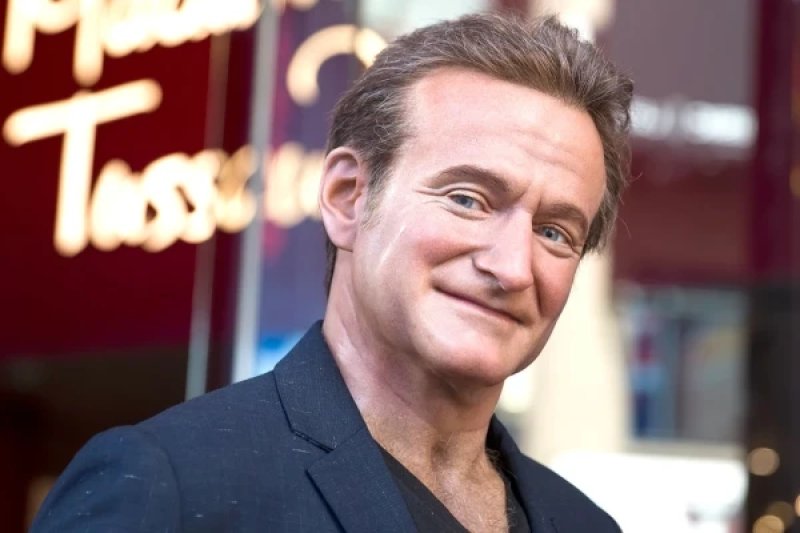
Undoubtedly, Obama was as shocked by the actor's death as other Americans and indeed, viewers around the world. The 63-year-old Williams took his own life seemingly out of nowhere. At first, everyone attributed it to ordinary depression. Then it turned out that there was a specific neurological reason: Williams suffered from Lewy body dementia (initially he was diagnosed with Parkinson's disease - the symptoms are largely similar). His widow later said, "In my husband's brain, there was like a terrorist... His brain was falling apart." A terribly sad ending for one of the best American comedians. Today, Robin Williams would have turned 75... As a child, he was a quiet and rather chubby boy. His father worked as a foreman at an automobile factory, and his mother was a former model, appeared in advertisements, had a sharp mind and a great sense of humor. Robin sometimes performed in front of her, trying to make her laugh. However, his parents were rarely home - a housekeeper took care of raising the boy. The house, it should be noted, was huge - 40 rooms; Robin, the only child in the family, had an entire floor to himself. He gradually filled it with toy soldiers, of which he had thousands. In high school, he tried performing in school plays, which turned out to be an excellent remedy for his shyness. He then attempted to study political science, but it turned out to be categorically not to his liking. He went into acting. His father advised him to study something practical alongside it, something he could use to make a living if necessary - like welding. At the first class, Robin and the other students were told, "You can really go blind doing this work," and he decided to fully dedicate himself to acting. At Juilliard, he studied with "Superman" Christopher Reeve, and according to Reeve, he sometimes made other students laugh so hard from the stage that "it was physically painful." Obama's words, "he came into our lives like an alien" refer to the role of Mork, who first appeared in the sitcom "Happy Days," created by Garry Marshall (the future director of "Pretty Woman"). His seven-year-old son was only interested in space and advised his father to include something related to aliens in the series, even if it was just in the context of the main character's dream. Marshall came up with the humanoid Mork from the planet Ork, who was to be at the center of one episode. The actor Roger Rees, who was cast for this role, backed out at the last moment. Then someone suggested bringing in stand-up comedian Robin Williams; it turned out that Garry's sister, Penny Marshall (the future director of "Big" with Tom Hanks and "Awakenings"), was familiar with this young man's work and fully supported the idea. Williams charmed the producers at the auditions and then the audience. Marshall recalled, "We said, 'No, this is not a dream, it's all real. This is a different show!' And very quickly, the show 'Mork & Mindy' was created for Williams, which was watched by 60 million viewers. Not to mention, less than a year after the first episode aired, Williams appeared on the cover of Time magazine. In 1980, he played his first leading role in film - in Robert Altman's "Popeye," based on the hugely popular cartoon series. (One of the famous Hollywood stories: this children's film was shot in Malta amidst a wild drug haze, and the director later said, "There was as much dope on set as dirt; everyone who came to us brought another batch with them." Even film reels were used to transport substances to the set. The producer was eventually arrested for drug possession). "Popeye" broke even at the box office but did not become a blockbuster; Altman experienced a creative crisis that lasted until the early 90s. But Williams was doing well: soon "The World According to Garp" was released, followed by "Moscow on the Hudson," where he played saxophonist Vladimir Ivanov, tired of life in the stagnant USSR with its eternal shortage of toilet paper and who remained in the USA during a tour (his co-star in the film was Savely Kramarov). Williams had no trouble finding good roles. However, by the middle of the decade, he said in an interview, "My main problem in film is that I am a character actor. I don’t like the pressure of having to drive the plot. It’s difficult. I think I just don’t want to be the main star of the film." And yet he was constantly called for leading roles, and he agreed - especially when the roles were dramatic. "Good Morning, Vietnam," "Dead Poets Society," the aforementioned "Awakenings" based on Oliver Sacks' autobiographical book - there, Williams played a neurologist who finds a way to bring people out of the stupor caused by encephalitis, in which they had spent decades... One of the patients was played by Robert De Niro, and during the filming, Williams awkwardly waved his hand and broke his nose; however, De Niro was even pleased, noting that his nose had already been broken before, and Williams' hit corrected its shape. And when De Niro had to shoot a scene where an insect was crawling on him (he is terrified of them), Williams calmed him down by performing a skit with a cockroach, who was in despair over not passing the audition. Oliver Sacks, a leading expert on Tourette syndrome (he was one of the first to seriously write about this condition), observed all this and said that Williams had a "voluntary Tourette syndrome." Overall, without this, it was impossible: the most serious roles were usually intertwined with comedic ease for Williams. The peak came in the 90s. He worked with Gilliam ("The Fisher King"), with Spielberg ("Hook"), with Mike Nichols ("The Birdcage"), voiced the genie in the super-popular "Aladdin." "Mrs. Doubtfire," with the old and foolproof comedic device of "a man disguising himself as a woman," with a budget of $25 million grossed $441 million (today, accounting for inflation, it would be over a billion). "Jumanji" grossed less but still became a cult classic for millions of teenagers around the world. For "Good Will Hunting" and the role of the psychotherapist convincing brilliant mathematician Matt Damon not to bury his talent, Williams finally received an Oscar. There was nothing funny about the two best roles he played in the 2000s: a maniac in Christopher Nolan's "Insomnia" and a little man going insane from the total absence of happiness, human communication, and love in Mark Romanek's film "One Hour Photo." More than twenty years ago, he gave an interview to film critic Stas Tyrkin. Williams said, "I would edit my life from 35 to 39... Although I remember so little of that whirlwind of parties! Instead, I have a black spot! But there was something good in them... Five wild, lost years!" And then he came out of a binge: "I was about to have my first child. If you don’t want to miss this event, if you don’t want your little son to kick your lifeless body and babble, 'Daddy is in a stupor today!' - you have to pull yourself together. My eldest son is now 21 years old - I quit drinking and using drugs six months before he was born. I did it without any doctors. I just told myself: stop, and... My brain immediately thanked me. I finally felt like the cats had stopped shitting in my mouth in the mornings. Fortunately, during those years of drinking, I did not ruin my career. I had enough sense to make sound decisions. Although alcoholism made it difficult to stay in shape, to lose weight when it was necessary..." According to Stas, "in answering questions, this very well-dressed gentleman alternated between behaving like a complete child and, as an interjection, using the word 'fuck.' He got excited, engaged in the game, and within a short time of the interview managed to portray: a ghost, a robot, a drunkard, a moron, Napoleon, Jack Nicholson, and even Death as a rapper. He was not dull and gloomy like most professional comedians. He behaved like a rascal, but despite the constant 'charge of positivity' emanating from him, somewhere deep down, the fragility of his being was read, the dramas he had experienced were felt.