

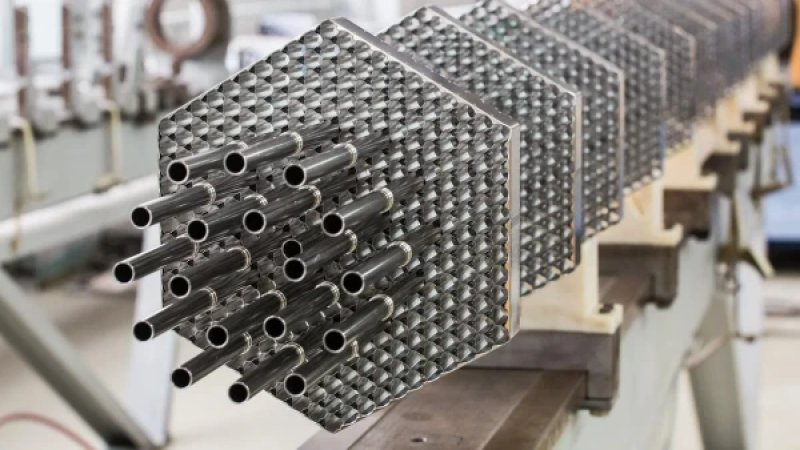
The German authorities have given the green light to the controversial Franco-Russian nuclear project in the federal state of Lower Saxony, despite criticism from politicians and experts. The Ministry of Environment of Lower Saxony, on behalf of the federal government, issued a permit to the Advanced Nuclear Fuels GmbH (ANF) plant in Lingen to produce fuel assemblies of Russian design in partnership with the state corporation "Rosatom." This was announced in a press release from the agency published on Wednesday, July 22. ANF, a subsidiary of the French state-owned company Framatome, applied for a permit to operate a new production line in March 2022 - just a few weeks after Russia began its full-scale invasion of Ukraine. The new fuel assemblies (TVS) for nuclear power plants are planned to be produced under a license from the Russian company "TVEL" - a subsidiary of "Rosatom." They may be used in the Czech Republic, Hungary, or Bulgaria, where nuclear power plants based on Soviet and Russian technologies are still operational. ## ## Conditions for Project Implementation The basis for the decision was a conclusion from the federal government, prepared in February with the participation of the Federal Ministry of Environment, the Chancellor's Office, and the German Ministry of the Interior. The document assesses the security risks and proposes special conditions under which the project can be implemented. Among them are: access to the workshops for employees of "Rosatom" "only in exceptional cases and accompanied," as well as thorough inspection and isolation of Russian machinery and software from the plant's IT infrastructure. Against the backdrop of the Russian invasion of Ukraine, when the European Union has aimed for energy independence from Russia, Framatome's plans have sparked outrage among environmentalists and civil activists. They believe that cooperation with the Russian state corporation increases the risks of espionage and sabotage. ## ## Criticism of the Project in Germany The project has been criticized by several German parties and environmental activists. The Green Party's expert on nuclear energy, Harald Ebner, stated that the federal government "had a powerful legal tool in hand to prevent 'Rosatom' from entering Lower Saxony." According to him, instead, Berlin allows Moscow "to further expand its tools of geopolitical blackmail at the expense of Europe." Criticism also came from representatives of the Christian Democratic Union (CDU). "The federal government must immediately put an end to this security roulette. We will thoroughly examine the permit and accompanying conditions and reserve the right to take further steps," said Bettina Ackermann from the nationwide anti-nuclear organization .ausgestrahlt. She pointed out that the online petition "No nuclear deal with Putin" has been signed by more than 125,000 people demanding an end to cooperation with the Russian nuclear giant.