

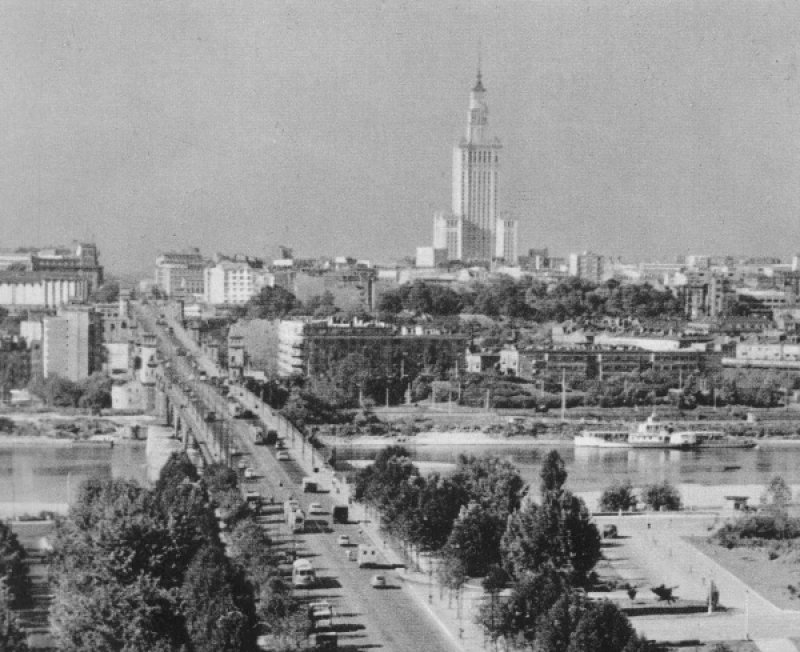
While sorting through family archives, I found a horizontal notebook with a brown leatherette cover, embossed with the words: "Album for Poems." And on the title page: "Excursion to Poland from October 23 to November 5, 1956." A travel diary kept by my grandfather, Nikolai Ivanovich Novokhatsky, the chief accountant of "Latpobresoyuz" – the republican association of cooperative trade. ## "Trust in Tourists – Just a Declaration" At the border, which ran along the Bug River, near the famous Brest Fortress, the train was inspected by Soviet and Polish border guards. "Red signs with the emblem of the USSR and white-red with the single-headed Polish eagle." Duty-free, one radio receiver, one camera. A Polish train approaches with 1st and 2nd class carriages. "The first stripes, narrow ribbons of land. 6 houses – 6 haystacks," notes Nikolai Ivanovich, a native of the Voronezh region. A mass of horses – but no cars at all. The first Polish station is Siedlce. "We step onto Polish soil. A 10-minute stop. We go to the station without a penny in our pockets. A book and newspaper kiosk 'Rukha' – with pacifiers, corkscrews, and cigarettes. 80 groszy were found among the Lithuanians – and we have a Polish weekly dedicated to the 8th plenum, Gomulka's speech, and the resolution of the CC of the Polish United Workers' Party on the beginning of the great correction process." Historical context: The 8th plenum of the CC of the Polish United Workers' Party (held from October 19 to 21, 1956) was a turning point in Poland, marking the beginning of "Polish October." It signified a departure from rigid Stalinism and brought Wladyslaw Gomulka to power, who proclaimed the "Polish road to socialism." The plenum took place against the backdrop of tense confrontation with the Soviet leadership. A delegation led by Nikita Khrushchev arrived in Warsaw on October 19, threatening military intervention; however, Gomulka managed to convince Moscow that these reforms did not threaten Soviet interests. During the same days, armed confrontation was ongoing in Hungary. "A Reminder of the Horrors of the War 1939-45" The Latvian group traveled 2000 km across the country on a French bus from the local travel agency Orbis – following the route Warsaw-Gdansk-Silesia-Krakow-Zakopane-Warsaw. In the capital, it was dark at night, "but noticeable new construction." "Through the efforts of the states, the entire nation with the help of the Soviet Union, the dead city has turned into a lively bustling capital of New Poland. Almost all the monuments of antiquity, to which the Warsaw residents are particularly attached, have been restored. Palaces, monuments, and 63 churches!" Every sixth resident of the city is a builder, a highway East-West has been laid, with a tunnel, 20 new districts have risen, the largest being Mirov, Murano, Mokutov. A mass of industrial enterprises, 30 thousand students. "The brotherly cemetery of Soviet soldiers in Warsaw. 22 thousand graves of Soviet officers and soldiers. Majestic obelisk on a huge staircase-approach. The ghetto in Warsaw. A monument to the 500 thousand Jews who perished in the uprising of May 8, 1943. There were 4 square kilometers of buildings that were leveled to the ground. Another wasteland with a monument."  _In 1956, Gomulka had nationwide popularity. Photo from the author's archive._ Nikolai Ivanovich, who went to war on June 22, 1941, and participated in the first successful counteroffensive of the Red Army near Yelnya, was awarded the Order of the Red Star and medals. Therefore, for a relatively recent – only 11 years have passed – front-line soldier, everything related to the war was sacred… "On the streets-sidewalks by the walls, crosses-flowers in memory of those shot by the fascists. In Poznan – a monument and a brotherly cemetery at the Citadel, where 6 thousand of our soldiers and officers are buried. The same in Zakopane. Auschwitz – a territory of 40 square kilometers. The camp housed up to 480 thousand people at the same time. A colossal city of barracks-blocks. 4 million people perished and were destroyed – Poles, Jews, Russians…"  _During the trip to Poland, my grandfather was 50 years old._ ## "Palace of Science and Art in Warsaw" The travelers visited a newly opened skyscraper – in the style of Stalinist high-rises in Moscow. "Exhibition of painting. Formalism. Modernism. Spatial composition – a sculpture awarded 'The Runner' – the emblem of the Olympic Games. Textile exhibition. Photo and radio exhibitions 'Zeiss' in Warsaw… A congress hall for 2800 people with 8 lines-languages and apparatuses that change the air." In Poznan, the tourists attended the opera "Madame Butterfly," in Gdansk they were taken to the new cinema "Leningrad" with 1200 seats, showing an English film. "Nonsense," summarizes the Soviet viewer. "To spend time in the cinema – to relax. The seats are soft – spacious, plenty of room between the rows. But in the foyer, people smoke – they don't rush you to the restroom. Out of 30 cinemas in Warsaw, only in 2 are our films – 'Othello' and 'Unfinished Story.' In all major cities, there are clubs of international friendship. "A bookstore, reading room, cafe without bread." In the cultural program were both the royal castle Wawel in Krakow and the Lenin Museum in Zakopane. "The winter capital. A dozen boarding houses. The first snow and the first outings on skis. Snow and sun – mountains – beautiful." "In Zakopane, we saw a living Russian countess… A brother had a large estate near Ryazan. The grandchildren really want to visit the USSR." ## "The People Are Dressed Neatly" An experienced professional in trade, Nikolai Novokhatsky noted both the mutual politeness of the gentlemen and ladies, as well as that "bread is transported in dirty vans, but on every loaf, there is a label from the brigade, the number (tag)." "Apples, pears on trays. Large department stores in Warsaw, Poznan, Krakow. Great attention to shop windows. There are many goods." At the same time, the standard of living in post-war Poland, to put it mildly, left much to be desired. The average salary in 1956 was 1118 zlotys. Meat cost 32 zlotys per kg, sausage 40, sugar 14, watches 800, bicycles 2000, radios 3000. Of course, at such prices, everything was always available for free sale! Ration cards were completely abolished in 1953. "Trade in vodka and wine is not conducted on Saturdays (until 12) and Sundays, as well as on paydays," noted a practical economist from Riga. "90 groszy from each bottle goes to benefit schools and children." "French wine, alcohol." ## "We Are Always with the Soviet Union" Thus, upon meeting guests, the miners of Silesia said. However, the guide Vladek informed the guests that a "bloodless revolution" had taken place in the country. On the 15th floor of the Soviet-designed skyscraper, the delegation was greeted by pioneers: "Greetings to the workers of Latvia!" Particularly interesting was the communication in Poznan, where mass strikes occurred in June 1956, which were harshly suppressed by the Polish Army. "Meetings with cooperators… 'We are always with 200 million – with the USSR, we are not rebels.' At the same time, the Pole complained that materially he "lives worse than in 1950." Poles retire at 65, Polish women at 60 (in the USSR, in 1956, the norms were set 5 years younger!). And here they attended a speech by the leader of People's Poland himself. "Hundreds of thousands of people. Proximity to Gomulka. Singing 'The Internationale'… Gomulka's call for calm: 'It's time to work, to demonstrate less.' In the evening, a student demonstration. Slogans: 'Friends, let’s help the Poles follow the Polish path!' Well, what can one add, golden words – for any country.