

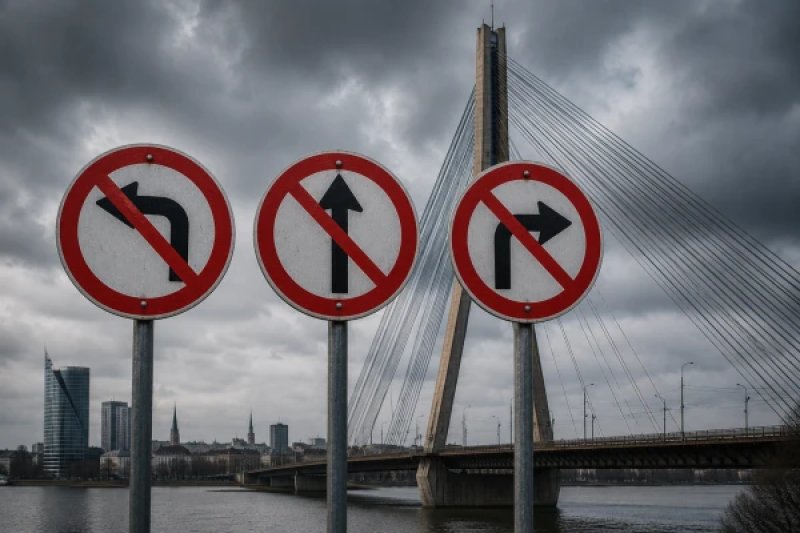
The reconstruction of the Cable-Stayed Bridge, costing 70 million euros (excluding VAT), is scheduled from the third quarter of 2027 to the second quarter of 2029. Currently, the design phase is ongoing and is expected to be completed by June 2027, reports Diena. Riga Mayor Viesturs Kleinbergs stated during the *900 seconds* broadcast that during the most challenging phases of the work, there is a possibility of completely closing the bridge to private transport. At the same time, the city intends to develop alternative modes of transportation, including the creation of new Park&Ride parking lots on both sides of the Daugava River. There are also hopes tied to the completion of the fourth phase of the Southern Bridge and the possible launch of rail services to Bolderāja. It is expected that these measures will help at least partially reduce the load on the city's transport network. However, it is already clear that avoiding inconveniences will not be possible. According to the plan, during most of the reconstruction, traffic should be maintained in at least one lane in each direction, although the bridge may be completely closed during certain short phases. The main question remains open — how exactly traffic will be organized. More detailed detour schemes and restrictions, according to the Riga City Council, are expected to be presented only in the fourth quarter of this year. SEB Bank economist Dainis Gašpuitis believes that the prolonged repairs will inevitably complicate movement in the city. According to him, much will depend on how well the city prepares alternative routes and how timely it informs residents and businesses. Uncertainty itself can create additional difficulties. The most sensitive consequences may affect businesses that rely on constant communication between the two banks of the Daugava River. The Latvian Employers' Confederation believes that service, trade, catering, logistics, construction, and healthcare sectors, as well as companies whose employees and suppliers regularly cross the river, are at the highest risk. This means that difficulties may arise not only for motorists. Longer trips could impact delivery times, staff operations, and the availability of certain services for clients. At the same time, the Riga City Council has not yet been able to specify which areas and businesses will be the most vulnerable. According to Gašpuitis, the economic effect will likely remain local and primarily affect Riga. The impact on the Latvian economy as a whole is expected to be minimal. There is about a year left before construction work begins, so the city still has time to prepare the transport infrastructure. However, the full scale of future restrictions can only be assessed after the publication of a detailed traffic organization plan.