

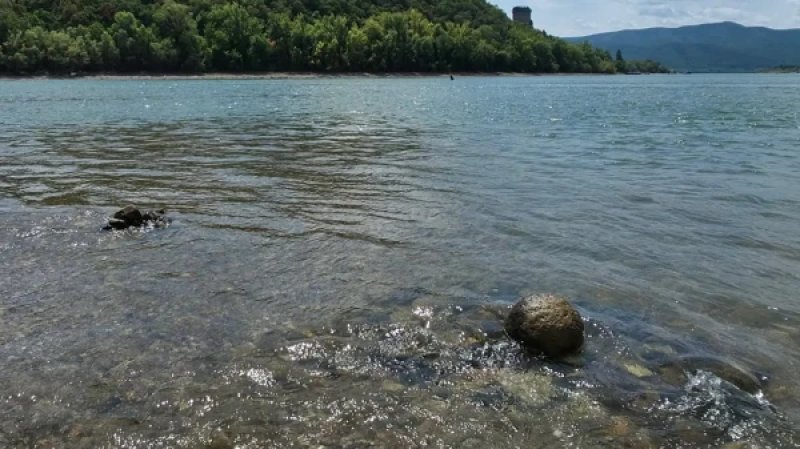
On Thursday morning, it dropped to an unprecedented low of 23 centimeters. This is 5 centimeters lower than the day before and 10 centimeters below the previous record set in 2018. This data is provided by the capital's water resources management. The reason for this natural anomaly is high temperatures and drought. Hungary is experiencing its second heatwave of the season. The Danube is rapidly shallowing, with more and more patches of land appearing. The situation is so unusual that the head of the Hungarian Cycling Club, Gabor Deje Kurti, was able to ride his bicycle along the riverbed from Budapest to Vác, which is over 30 kilometers. A few days ago, a passerby stumbled upon a strange object on a sandbank near Visegrád - a large stone almost perfectly round in shape. He reported the find to the King Matthias Museum in Visegrád. Initial assessments by specialists suggested that it could be a cannonball fired from a catapult. We contacted the museum director, archaeologist Gergely Buzás, who stated that such finds are not uncommon in the area: during sieges, the Visegrád fortress was bombarded with hundreds of such projectiles, and several similar artifacts are stored in museums. Museum specialists will visit the site next week to examine the stone ball and confirm whether it is indeed an ancient projectile. How ancient it is can only be speculated; its exact age cannot be determined. According to Buzás, it is known that such projectiles were still in use no later than the 16th century. One could delve into an even older history, as there was a fortress here during the Roman period, and stone-throwing machines existed then as well. Thus, if it is confirmed that this is indeed a catapult ball, it means it was made at least 400, and possibly 2000 years ago. And it has been lying at the bottom of the Danube ever since. Such discoveries are not isolated: last week, a World War II-era ship was found in the drying riverbed of the Danube near Mohács. ## ## The Drought Shows No Signs of Ending On Wednesday, the Copernicus Earth Observation Service, operating under the EU, published a satellite image of the area where the mysterious stone ball was found — the Danube bend. The collage shows the same section of the Danube in images from July 14, 2025, and July 25, 2026. The comparison of the two images clearly shows: this year, the water levels in the Danube are significantly lower than in July of last year. In the bends of the river, sandy shoals have emerged, severely complicating navigation. In certain sections of the Danube, neither cargo nor passenger vessels can pass, and in Budapest itself, restrictions on river traffic have been imposed. The head of the Ministry of Environment, László Gajdó, announced a state of emergency on Wednesday to combat the drought. In the morning, he reported that in "66 out of 84 water deficit management zones, the drought index exceeds the legally established triple threshold," meaning that three-quarters of the country is experiencing a serious water shortage. According to meteorologists' forecasts, no rain is expected in the next two weeks. The heatwave that began on Wednesday will peak in about a week: maximum temperatures of around 39 degrees are expected in the capital. Some relief is only anticipated by the end of next week, but even then, daytime highs will remain at around 31–33 degrees.