

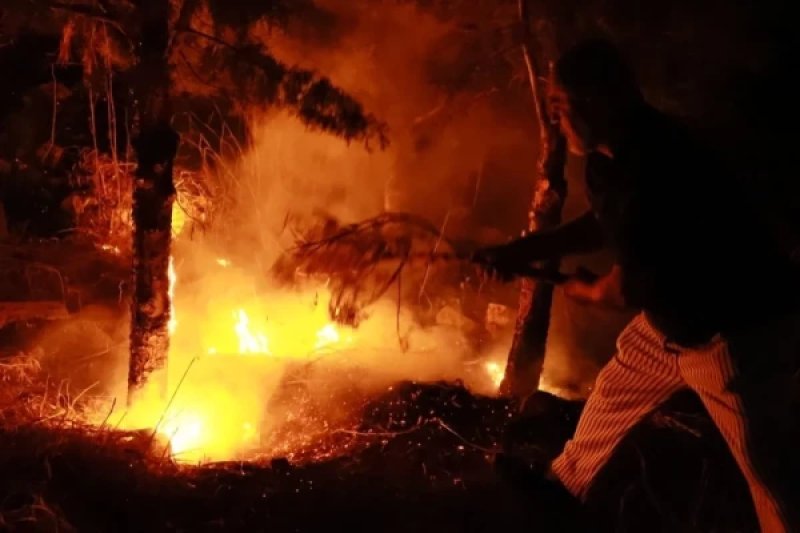
At the end of July 2026, a wave of wildfires swept across the southwestern coast of Turkey. The fire approached popular tourist areas — Antalya, Kemer, Alanya, as well as the province of Mugla, home to the world-famous resorts of Fethiye, Bodrum, and Marmaris. Against the backdrop of abnormal heat, which currently exceeds 50 degrees Celsius, and strong winds with gusts up to 76 km/h, the flames are spreading at an enormous speed. **What is currently happening with the fires in Turkey and is the situation dangerous?** As of July 30–31, 2026, Turkey has recorded between 90 and 115 fire outbreaks. The most severe situation has developed in Antalya, Mugla, and Balikesir. In Antalya, the fire is raging in the areas of Kas, Kumerca, Aksu, and Kundu. In the Aksu area, where well-known hotels are located, tourists are complaining about heavy smoke. Due to the fires, the main highway Antalya — Fethiye is closed, and operations at Gazipasa Airport in Alanya have been partially disrupted — some flights have been redirected to Antalya. In Mugla, five major fires have been registered. In the Seydikemer area, between Fethiye and Marmaris, the fire started on farmland and spread to forested areas. Currently, 408 houses, 703 people, and about 100 animals have been evacuated, and 55 buildings have been damaged. A local hospital with 45 patients has also been urgently evacuated. On the Aegean coast, five separate fires have been recorded, including in the resort town of Altinoluk, where 210 houses have been evacuated. The fires have affected the provinces of Izmir and Canakkale. The fire spares neither residential houses nor agricultural land, and the sky over the regions has turned a crimson-orange color. **What measures are being taken to extinguish the fires in Turkey?** Currently, Turkish authorities have mobilized all forces: 21 planes, 69 helicopters, about 500 units of special equipment, and more than 3,500 rescuers. Aviation is continuously dropping water on the most dangerous areas. Russia is also providing active assistance — two Be-200 amphibious aircraft have already spent over 35 hours in the air over the emergency areas. In total, more than 100 helicopters and about 30 planes are involved in the firefighting efforts. Turkey's Minister of Agriculture and Forestry, Ibrahim Yumakli, urged citizens to exercise maximum caution — he warned of gusty winds up to 80 km/h. Despite the efforts, strong winds and heat seriously complicate the work of firefighters. **When will the fire subside?** Meteorological forecasts do not provide grounds for optimism. In the coming days, temperatures in Antalya are expected to reach 41 °C, and in Mugla, 37 °C. Strong winds are expected to persist at least until August 1, after which their speed should decrease. The risk of new fires is assessed as extremely high. A slight decrease in temperature to 32 °C is expected in the first decade of August, but rain is still not forecasted. Experts warn that 2026 may become one of the most fire-prone years, as Europe is expected to experience abnormal heat, prolonged drought, and the accumulation of dry vegetation after heavy spring rains. **Who is threatened by the fires?** The main impact of the disaster is being felt by residential areas and local residents. In Antalya, residential houses are burning, and in the province of Mugla, dozens of buildings have been destroyed. Evacuations have been conducted for several hundred people in the risk zone. Some roads, including the Antalya — Fethiye highway, have been closed, and access to the ancient ruins of Olympus has been restricted. Tourists are strongly advised to refrain from excursions in the mountains and canyons.