

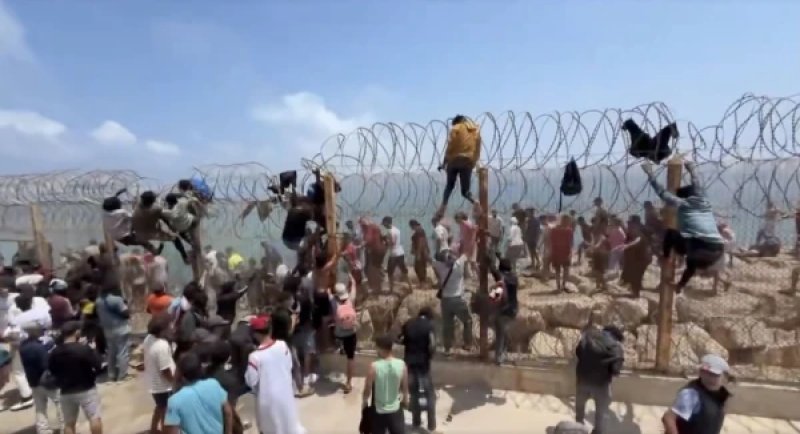
 Foto: BB.LV / мигранты перелезают через забор
Latvia joined a joint appeal from 22 European Union states urging EU leadership to take immediate action in response to the sharp escalation of the migration situation in the Spanish enclave of Ceuta on the border with Morocco. The letter, initiated by Italy and Denmark, was sent to the President of the European Council Charles Michel, the President of the European Commission Ursula von der Leyen, and the Prime Minister of Ireland Micheál Martin, whose country currently holds the presidency of the EU Council. The authors of the appeal express serious concern over the rise in illegal migration at the external border of the European Union and believe that the situation requires a swift and coordinated response from all member states. "The security of the external borders of the European Union is a shared responsibility of all member states, and their effective protection is a crucial condition for our collective security," said Latvian Prime Minister Andris Kulbergs. According to him, the European Union must demonstrate its ability to effectively protect its external borders and respond uniformly to illegal migration, as well as to any attempts to use migration flows as a tool for pressure. In fact, the appeal reflects the desire of some EU countries to achieve more active coordination of actions at the level of the entire union, rather than leaving the resolution of such crises solely to the states directly faced with an influx of migrants. The authors of the letter call on European institutions to act quickly and collaboratively to prevent further deterioration of the situation and to strengthen the protection of the external borders of the Schengen Area. The appeal was prompted by the largest migration crisis in recent years in Ceuta. According to Spanish authorities, the number of dead has reached 67 people. Among the victims are individuals who drowned while attempting to reach Spanish territory, as well as those who died in a stampede. According to the Ministry of the Interior of Spain, most migrants who previously entered Ceuta have already returned to Morocco. Despite this, authorities acknowledge that the situation in the city has not yet fully stabilized. The President of Ceuta, Juan Jesús Vivas, stated that the life of the city is still disrupted by the consequences of the crisis, although the process of returning migrants is proceeding successfully.
