

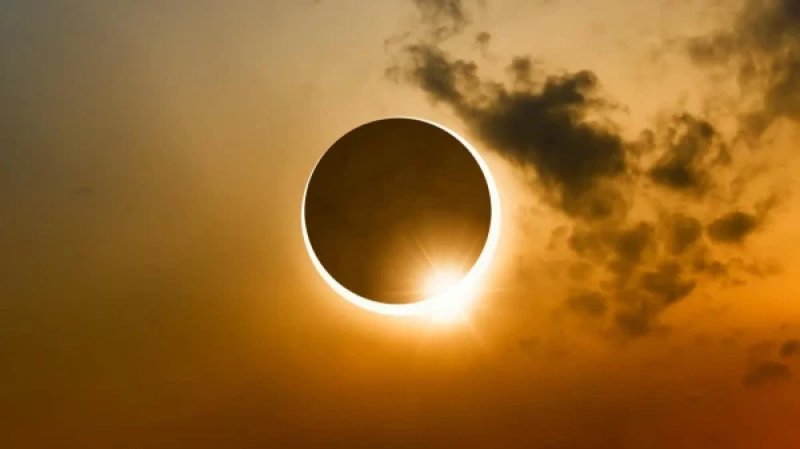
The total solar eclipse will occur on August 12 and will be one of the most significant astronomical events of the year. It will coincide with the peak activity period of the Perseid meteor shower, providing skywatchers with two impressive phenomena at once. The uniqueness of this eclipse lies in its longer duration compared to usual. This is because, on this day, the Moon will be at perigee — the closest point to Earth in its orbit, making it appear larger visually and allowing it to cover the Sun for a longer time. The best conditions for observation are expected in the western part of Iceland and northern Spain. The longest total phase of the eclipse is forecasted at the Látrabjarg cliffs in Iceland. Residents of Reykjavik, Ísafjörður, and other cities along the country's western coast will also be able to see the eclipse in its entirety. However, experts believe Spain to be the most favorable location for observations. The path of totality here covers a significantly larger area, and the likelihood of clear weather in August is much higher than in Iceland. Residents of Bilbao, Burgos, Palma, Santander, Valencia, Valladolid, and Zaragoza will be able to see the eclipse in full. A small section of northeastern Portugal — the Montesinho Natural Park in Bragança district — will also fall within the path of totality. Additionally, the total eclipse can be observed in some hard-to-reach areas of Greenland and Russia, but getting there without a special expedition will be challenging. Partial eclipse will be visible to residents of the northern states of the USA, eastern Canada, and several European countries. The degree of coverage of the Sun by the Moon will vary significantly depending on the region. For example, in New York, the Moon will cover only about 9% of the solar disk, while in St. John's, Canada, it will be approximately 53%. In Riga, the maximum of the eclipse is expected around 20:55, when the Sun will be low on the horizon. At this moment, the sunset is anticipated to take on an unusual silvery hue. Astronomers remind us that observing a solar eclipse without special protective glasses is not allowed. Using regular sunglasses does not protect the eyes and can lead to serious vision damage. Only specially certified filters allow for safe observation of this rare celestial phenomenon.