

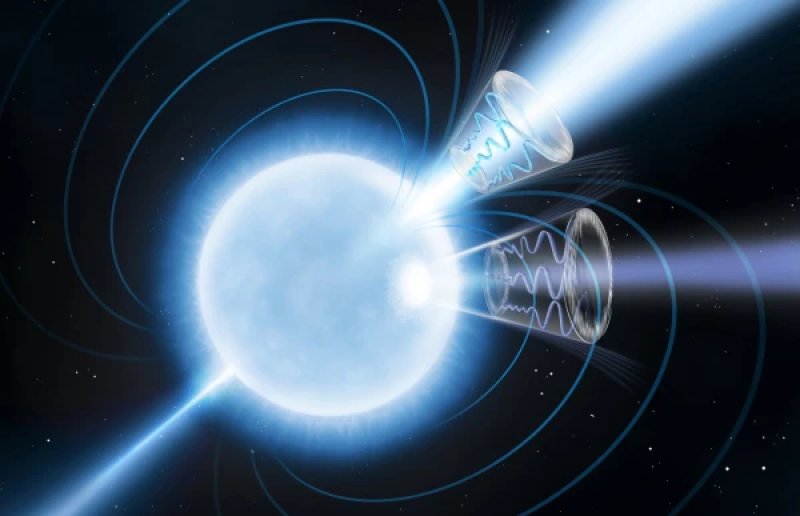
An international group of scientists, using NASA's IXPE space X-ray observatory, has obtained data that may confirm a theory proposed nearly 90 years ago. This concerns the phenomenon of vacuum birefringence — an effect in which strong magnetic fields alter the properties of empty space itself. The research results are published in the journal Nature. The subject of observation was the magnetar 1E 1547-5408 — one of the most unusual types of neutron stars. Magnetars possess the strongest magnetic fields among all known objects in the universe — about a trillion times stronger than the most powerful permanent magnets created by humans. Neutron stars arise after the death of massive stars. Despite their sizes comparable to that of a large city, they contain a mass exceeding that of the Sun, making them unique natural laboratories for studying extreme physics. From March to April 2025, scientists observed the magnetar for over 140 hours. In addition to IXPE, the NICER X-ray telescope and the Australian radio telescope Murriyang were used. This marked the first time in history that the polarization of radio and X-ray emissions from a magnetar was measured simultaneously. The researchers discovered an unexpected feature: the degree of polarization of the X-ray emission was nearly three times higher than expected. Existing models cannot explain such a result solely through processes on the surface of the star, leading scientists to propose the existence of an additional physical mechanism. The most likely explanation turned out to be vacuum birefringence — an effect predicted back in 1936 within the framework of quantum electrodynamics. According to this theory, extremely strong magnetic fields can alter the properties of vacuum. As a result, empty space begins to interact with light similarly to a lens or prism, enhancing its polarization. Computer simulations confirmed that this effect best corresponds to the obtained data. As noted by researcher Hoa Dinh Thi from Rice University, "reproducing the observed characteristics of X-ray polarization while simultaneously matching the radio observation data can only occur in the presence of vacuum birefringence in the vicinity of a neutron star." According to her, such objects allow for testing fundamental physical laws in conditions that cannot be replicated in terrestrial laboratories. The lead author of the study, graduate student Rachel Stewart from George Washington University, emphasized that "the information obtained from studying this distant stellar core helps us better understand the very nature of reality." For now, scientists are only speaking of a possible confirmation of the theory. Additional observations of this and other magnetars will be required for definitive conclusions. If the results are confirmed, it will become one of the most compelling experimental evidences of the effects predicted by quantum electrodynamics nearly a century ago. The IXPE mission, created by NASA in collaboration with the Italian Space Agency and scientific organizations from 12 countries, continues to explore the most extreme objects in the universe, helping to test fundamental laws of physics. New observations may change scientists' understanding of how light and space itself behave under the extreme conditions of the universe.