

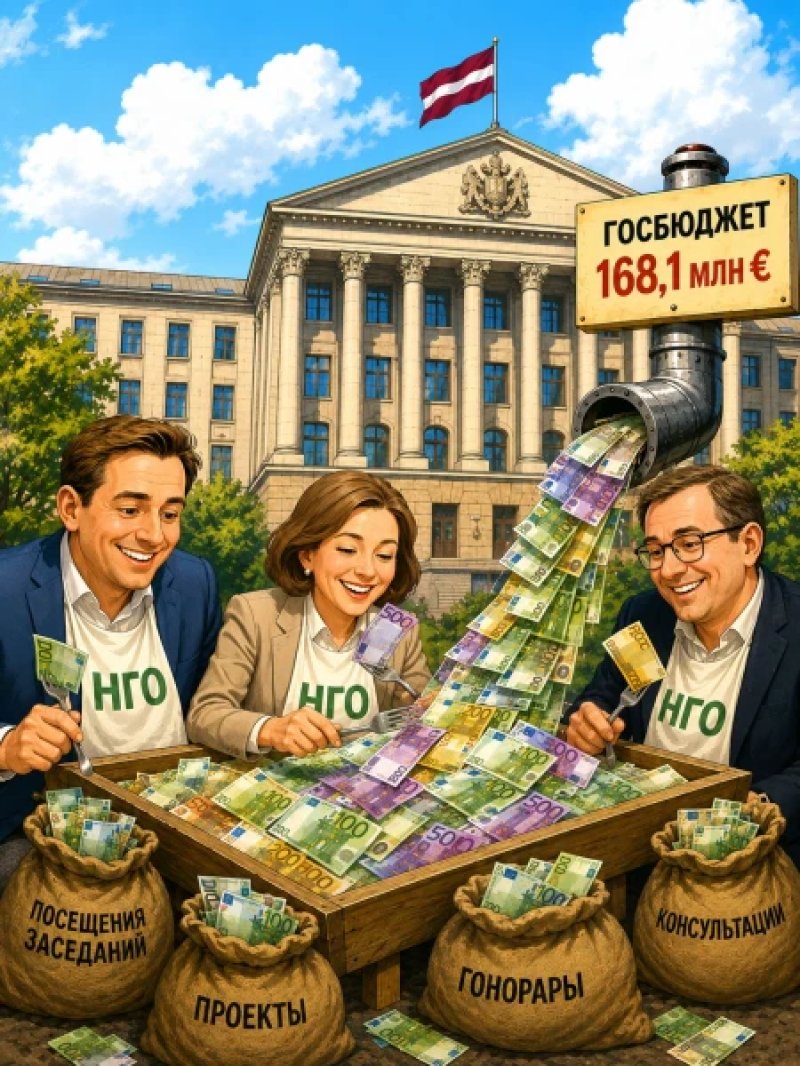
And such "beautiful" epithets ("shit" and "garbage") were uttered by Prime Minister Andris Kulbergs himself, evaluating... the documents prepared by the State Chancellery and the Ministry of Finance! ## Came, Saw, Received So what actually happened? As is known, for some time the Prime Minister came across a "budget estimate," which revealed that representatives of non-governmental organizations received fees from the state budget (through the State Chancellery) for... attending government meetings, committees, commissions, etc. A scandal began. The head of government demanded reports on which non-governmental organizations received state funding, in what amounts, and for which specific projects. However, the prepared reports did not provide any clarity, which further angered the Prime Minister. Of course, the Prime Minister is right in this case – it was high time to figure out why public (state) funding is only received by particularly chosen non-governmental organizations, what the criteria for providing state money are, and most importantly – what are the results of the work of those non-governmental organizations that receive (many organizations regularly) a kind of grants from the state treasury. To avoid being unfounded, we provide specific data. ## Money Only for the Chosen? Currently, there are 27,500 registered non-governmental organizations (NGOs) in Latvia. Of these, 1,940 organizations, or seven percent of all NGOs, received 168.1 million euros from the state budget in 2025, which is 29% more than in 2024. The increase in funding for NGOs last year cannot be considered a uniform growth of the entire sector. Of the total increase in funding, 89% (33.7 million euros) came from a small group of NGOs – 85 organizations. For them, funding from the state budget increased by more than 50%. The trend of growth continues this year – by mid-year, 98.2 million euros have already been disbursed, which is 10% more than for the same period in 2025. The majority of state funding – 145.5 million euros or 86.6% last year consisted of subsidies from the state and municipal budgets, as well as funding from EU projects and foreign states. The remaining 13.4% included services, social payments, and other subsidies. 22.9 million euros were allocated for subsidies to 453 organizations and were not tied to any project or service. Funding for the non-governmental sector is focused on a small number of NGOs: only 25 organizations received more than one million euros each last year or 40.8% of the total allocation from the state budget! Well, let’s hope that the Prime Minister manages to bring order to the funding of NGOs before the elections. In any case, this story on the eve of the elections is extremely beneficial for Kulbergs and his United List: voters like the tough rhetoric and the fight against those who have gotten their hands on the trough – in this case, the public activists who are energetically tapping into taxpayers' money. ## Is the Government No Longer Responsible for airBaltic? However, one cannot fail to notice another aspect – this scandal with NGOs was inflated by the Prime Minister (accidentally or intentionally?) at a moment when everyone is waiting to see how the Prime Minister and the government as a whole will decide the fate of airBaltic. It is obvious that the government will not be able to drag this out until the elections without making decisions – the financial situation in the national airline is too dire. But it seems the Prime Minister has already come up with... No, not a solution, but an excuse. On Wednesday, in an interview with LTV, Andris Kulbergs reminded that two years ago airBaltic issued bonds at usurious interest rates – 14.3 percent per annum. This allowed borrowing 380 million euros. And now, the Prime Minister explained, a paradoxical situation has arisen: on paper, the main owner of the airline is the state, but de facto the fate of the airline is in the hands of creditors (bondholders). And it is they who will decide what to do with airBaltic. At the same time, Kulbergs expressed his willingness to personally meet with potential strategic investors. All this is very interesting, but it is still unclear whether the government has a "Plan B" – in case a strategic investor is not found, and bondholders refuse to invest additional funds and extend the repayment period at least for the interest. For now, however, judging by the ratings, the trust of voters in Kulbergs and Co. is not exhausted... ## Close the Border and That's It! Ministers representing other ruling parties are also striving to get their 5 minutes of fame before the elections. For instance, the head of the Ministry of Interior, Janis Dombrava (National Alliance), as is known, has started a merciless war against immigrants, occasionally confusing legal and illegal migrants (voters of the National Alliance, in principle, do not care what these foreigners are called). In the course of his struggle, Dombrava went a bit too far and demanded to completely close the only border crossing point with Belarus. This is already in the realm of "to spite my mother, I’ll freeze my ears." After all, it is obvious to everyone that illegal migrants are trying to enter Latvia by any means, but not through the official border crossing! And closing the border will only harm ordinary residents, businesses, and drive another nail into the coffin of Latvia's transit and logistics sector. There are still almost two months until the elections – it’s scary to imagine what else Dombrava will come up with to boost the popularity of his party and his own! ## "Save" the Rating In the current situation, the Minister of Economics, Viktor Valainis (Union of Greens and Farmers), is also trying to remind people of himself. However, he has few options – the topic of supposedly sharp price reductions does not inspire voters, and in desperation, the head of the Ministry of Economics has already shifted to the communal and road problems of Riga. Here the minister really has room to maneuver – the capital has been brought to its knees! So far, however, the work in the government has only brought political dividends to Kulbergs and his political union. "New Unity" and the National Alliance, according to the ratings of the last two months, are barely overcoming the five percent barrier, while the "green farmers" have found themselves "beyond the line" and risk not getting into the next Saeima. One way or another, the three mentioned parties have virtually nothing to lose, and in the remaining almost two months until the elections, they will have to fight desperately for a place in the sun – including against each other, trying to win back the voters taken from them by Kulbergs.