

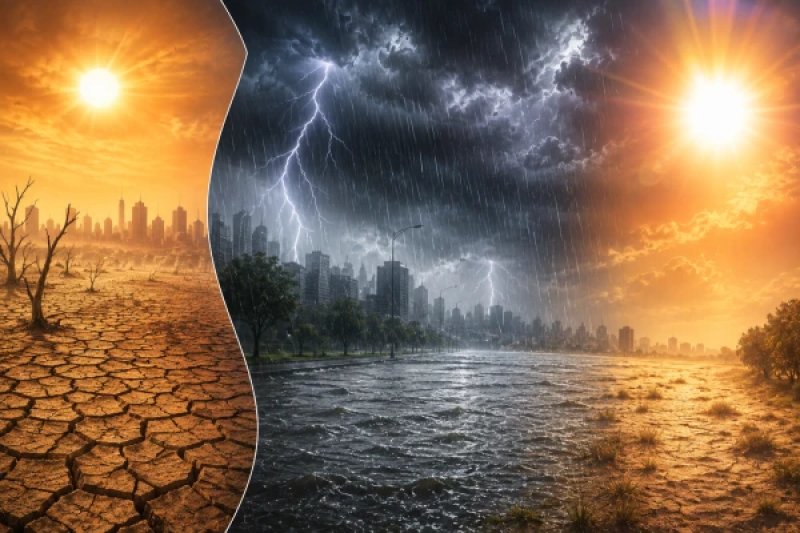
Such natural disasters are predicted by British scientists from the University of East Anglia, who published alarming results of their research in the scientific journal Earth’s Future. **The Earth is Drying Up, Rivers are Shrinking** Researchers have determined what will happen, for example, to ordinary rivers with an increase in the average temperature of the planet by just 2-4 degrees compared to pre-industrial levels. It’s relatively simple: high temperatures persist for several weeks, there is no rain, the land dries up, and rivers shrink. Then a cyclone arrives, pouring an enormous amount of water from the sky. Moreover, the dry soil cannot absorb it quickly. The streams rush into rivers and lakes, causing their levels to rise sharply. As a result — floods, soil erosion, and a sharp decline in water quality. The continuation of the scenario is even more frightening: after months of heavy rain, exhausting heat returns. High temperatures provoke moisture evaporation, the soil dries quickly, and water becomes scarce. And after a few months, heavy rains will come again... The hotter the planet gets, the more noticeable and abrupt these fluctuations — from drought to floods — can become. The picture is alarming: severe floods and prolonged droughts will not only become stronger, but they will also sharply, almost instantaneously, replace each other. Some scientists have already called this phenomenon a "hydroclimatic whip," while others refer to it as "climatic swings." **When to Expect the Impact of the 'Whip'?** Researcher at the Climate Research Center of the University of East Anglia, Yi He, points out another problem. Modern water supply systems and disaster protection complexes are often designed to combat a specific threat: either heat or floods. In the case of a hydroclimatic whip, people will need to stockpile water for the upcoming dry period. What size reservoirs are needed? Will such natural and artificial reservoirs withstand powerful floods? How deep should water purification be so that people can use it for their needs? A mistake in any of these calculations could provoke an apocalyptic scenario, at the end of which humanity may simply cease to exist. But the most alarming aspect of the British study is the speed at which the climate is changing on our planet right now. And if this process is not slowed down, the first impacts of the hydroclimatic whip will be felt by the current generation of Earth’s inhabitants.