

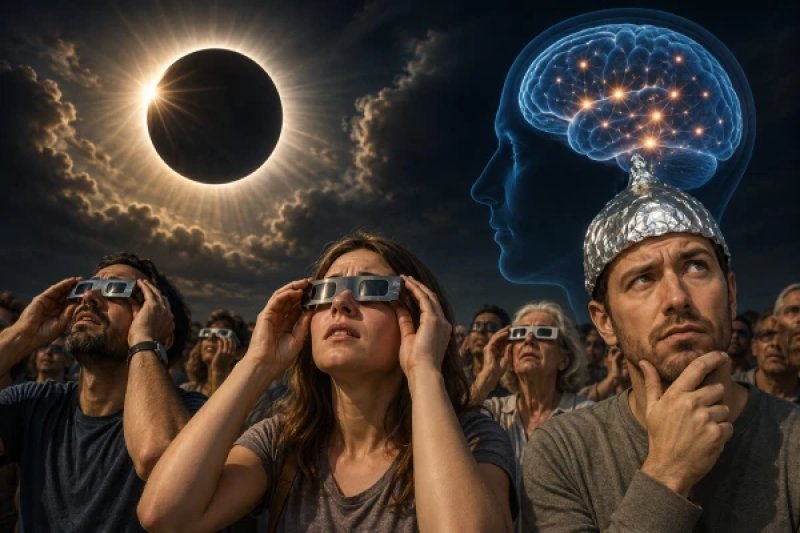
If you missed the latest news in astronomy, we inform you: on August 12, 2026, a total solar eclipse will occur, which will be the first in continental Europe in the last 27 years. On this day, the Moon will completely cover the Sun, plunging a narrow strip of land about 300 km wide into darkness. The total phase will be observable in Greenland, Iceland (including Reykjavik), and in the north and east of Spain (Bilbao, Valencia, Mallorca). In the rest of Europe, including Latvia, and in North America, the eclipse will be partial: the Moon will only cover the edge of the solar disk. In honor of this event, we decided to investigate whether a solar eclipse affects people in any way and if one can protect oneself with a tin foil hat. **Psychology: the "awe effect" and collective bonding** The main scientifically proven effect of an eclipse is the emergence of a deep sense of awe and wonder (the "awe effect") that people experience in the face of vast forces of nature. In a study published in the journal Psychological Science, researchers analyzed data from over 2.8 million social media users during the total eclipse of 2017 in the United States. The researchers found that people in the path of totality reduced their focus on their own "self": the pronouns "I" and "me" appeared significantly less frequently in their speech. They also exhibited altruism and empathy and felt a connection to humanity. In particular, the feeling of social isolation decreased at that moment, and people sought to gather in groups to share the experience of the event. Psychologists explain this by stating that the brief disappearance of the sun triggers an ancient evolutionary mechanism. The sudden drop in temperature and change in light evoke a primal controlled fear in people, which quickly transforms into delight. This causes consciousness to transcend everyday problems and realize itself as part of a vast Universe. **Physiology: real threats and myths** From a medical perspective, myths about spikes in blood pressure, headaches, or sudden aggression during eclipses remain unconfirmed superstitions. Systematic reviews of hospitalizations in psychiatric and somatic clinics on eclipse days do not record abnormal spikes in morbidity. Disorders may only occur in highly anxious individuals due to self-suggestion or fear of "omens". The only proven and serious danger is solar retinopathy. Sun rays, focused by the lens, can literally burn the rods and cones on the retina of the eye, and this process is completely painless due to the absence of pain receptors inside the eye. Damage can lead to irreversible vision loss or blindness. The only way to protect oneself from this is to use certified dark filters marked with ISO 12312-2.