

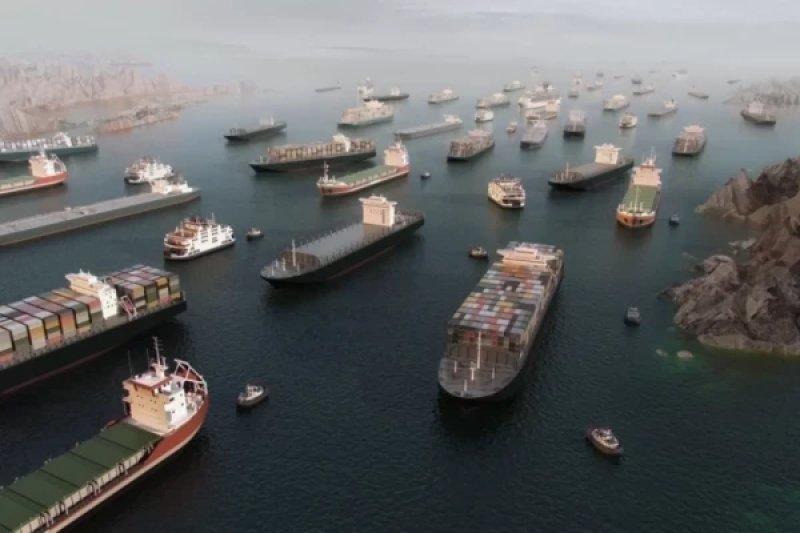
**Experts Sound the Alarm** According to marine biologists, the current situation is practically ideal for so-called biofouling. When a vessel remains stationary for a long time, its hull gradually becomes covered with a biofilm. Then algae, worms, and other marine organisms attach to it. Thus, one ship becomes a means of transport for millions of “passengers.” Typically, ships spend only a few days in ports, so this process does not pose a threat. But now the situation is fundamentally different. There are about 1,500 ships in the Persian Gulf, with several hundred more waiting to resume movement in the Gulf of Oman. Many of them have been idle for several months. **A Nightmare Becomes Reality** Scientists describe what is happening as unprecedented in terms of the potential spread of alien species. Moreover, the problem is exacerbated by seasonal factors: the water in the region has warmed up, and high temperatures accelerate the growth and reproduction of many organisms. One example is the barnacle Amphibalanus improvisus. At around 30 degrees Celsius, an adult can release up to 36 larvae per day. Over several months, a vast number of potential “passengers” can form on the hull of one ship, which will then travel to other parts of the planet. This is why researchers speak of the risk of bioinvasive super-spreading: a single ship can simultaneously transport millions of organisms from one region to another. **A Blow to the Economy** The main danger lies in the fact that an arriving organism may find itself in an environment where it has virtually no natural enemies. This allows it to reproduce rapidly, displacing local species: the seas could repeat the unfortunate experience of Australia, whose ecosystem has been severely affected by the uncontrolled reproduction of rabbits introduced by one of the farmers. The consequences can be quite material. Invasive organisms can disrupt the operations of fisheries and aquaculture, compete with local fauna, and even clog the cooling systems of power plants. Some alien species carry parasites and pathogens that may pose an additional threat to local ecosystems. Ports located in regions with similar conditions—warm and salty water—are considered particularly vulnerable. Among the potentially affected locations, scientists mention Jeddah, Mumbai, Colombo, Singapore, Alexandria, Piraeus, and Rotterdam. At the same time, the shipowners themselves may feel the consequences. The thicker the layer of organisms on the hull, the higher the water resistance. The vessel has to spend more fuel to maintain speed. Experts estimate that just a microbial film can increase fuel consumption by 2–5%. In cases of serious fouling with barnacles and mussels, this figure can reach 25%. **Stop Signal** The most obvious solution is to clean the vessels before they leave the region. But this is where the main practical problem arises: there are too many ships and not enough specialized services. An additional complication is the need not only to scrape off the organisms from the hull but also to collect them to prevent them from returning to the sea. Moreover, improper cleaning can damage the special antifouling coating. Such technologies already exist. In particular, modern robotic systems can clean the hull while simultaneously collecting biological material. However, their capabilities are currently insufficient for mass processing of thousands of ships. The International Maritime Organization recommended in 2023 to pay special attention to cleaning vessels that remain idle for extended periods. But the current scale of the situation significantly exceeds typical cases of idleness. Therefore, scientists suggest preparing for at least the next stage—inspecting and, if necessary, cleaning ships after their arrival in other ports. Otherwise, the ecological problem that has arisen in one of the planet's most important maritime hubs could have global repercussions. Researchers emphasize: the mere presence of organisms on hulls does not automatically signal an ecological disaster. Some species may not thrive, while others may not cause significant harm. However, among them could be aggressive alien organisms. This is why the reopening of the Strait of Hormuz will not only be a transportation event. Along with the stagnant ships, a whole army of invisible biological “agents” may enter the world’s oceans—and it is impossible to predict in advance where they will land and what damage they will cause.