

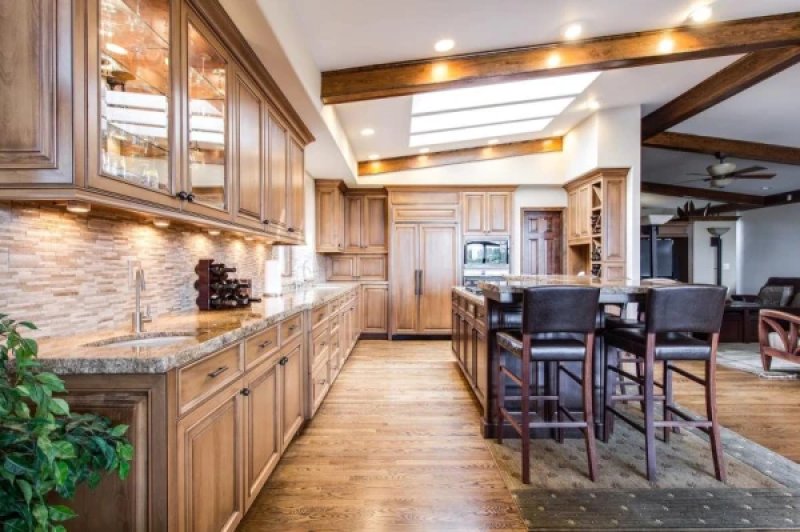
Many designers consider the kitchen, and in modern new buildings, the kitchen-living room, to be the most important room in the house. This is not surprising, as we spend a lot of time here. Therefore, when starting to transform and improve this area, the question arises: which materials should be preferred? This is especially true for flooring, which is subject to wear and tear. It must be resistant to spilled cups, broken dishes, and oil splashes, durable, and easy to maintain. Let's consider all the pros and cons of different materials. Linoleum: Many Advantages This material ranks at the top. It is not afraid of moisture, resistant to cold and hot effects, easy to clean, and has good thermal and sound insulation. Installation can be mastered independently, and the variety of options allows for any design ideas. Linoleum can be solid-colored or imitate stone, laminate, tiles, or parquet. It also has a reasonable price. Among the disadvantages is its relative resistance to deformation. Dents may form in places where furniture is placed. This can be avoided by using pads on furniture legs. Another downside is that some designers consider linoleum not to be the most attractive interior solution. However, the advantages of linoleum outweigh the disadvantages. For the kitchen, it is better to choose not the cheapest household option, but a commercial one with a thicker protective layer, which will significantly increase its lifespan. Laminate: Beautiful, but Not Always Practical This material resembles parquet made from fiberboard (particle board) with paper glued on top. It is available in various patterns and is often mistaken for granite, marble, or ceramics. Laminate is convenient and beautiful, but it is extremely impractical for the kitchen due to its fear of moisture. If liquid is spilled on the floor and not wiped up, the board may get damaged and require replacement. If you still decide to choose laminate, opt for a class of use no lower than 31–33, as it is used even in restaurants. Ceramic Tiles: Practicality at Its Best A durable surface, color resistance, and lack of reaction to moisture—all of this speaks in favor of ceramic tiles. Modern options of this material can imitate wood, natural leather, marble, and even precious metals, allowing for the creation of a kitchen in any style. It is an elegant and practical choice, but... Significant downsides of ceramics include slipperiness, the possibility of deformation when heavy objects fall, and a cold surface, especially in winter. The first problem can be solved by choosing matte or textured tiles, and the third can be addressed with a mat or a heated floor system. Wood: A Timeless Classic Eco-friendly and safe flooring is chosen by people with taste and means. It is important to choose parquet made from hardwoods: beech, oak, walnut, maple. The technology of thermal modification adds extra reliability, repelling water and not reacting to temperature fluctuations while preserving all properties and appearance. Regular untreated parquet requires careful maintenance. It is important to maintain the temperature regime and monitor humidity in the room, so professional advice is essential. Cork Flooring: The Future Is Bright Cork flooring is not afraid of moisture, does not deform, does not rot, and is warm, soft, and hypoallergenic (dust does not accumulate, mold does not thrive). It also absorbs sounds and provides comfort to the feet, reducing stress on the joints and spine. Despite its clear advantages, many still regard cork flooring with skepticism, considering it fragile and vulnerable, although this is not the case. Polymer Coating: An Expensive Pleasure Imagine that under the mirror surface of liquid polyurethane, you can admire any design solutions—from small objects to three-dimensional images. At lunch, you can gaze at the ocean floor or outer space—the choice is yours. However, when designing a 3D pattern, it is important to maintain balance and avoid tastelessness. For example, an endless sea with sharks may look impressive, but it is not always appropriate in a kitchen. Polymer floors are distinguished by their moisture resistance, durability, and ease of maintenance. The only downside is their high cost. Vinyl Tiles: An Interesting Newcomer These are vinyl linoleum pieces cut into various geometric shapes, allowing for unique installation compositions. An improved version of the covering is quartz vinyl, which becomes denser and more durable due to quartz sand. It is important that the surface on which the material is laid is perfectly flat and rigid. Such tiles cannot be laid on an unlevel floor. This is not the cheapest option, but the costs are justified by durability. Combined Flooring: An Unusual Solution If you like laminate and ceramic tiles, you can combine both materials. Laminate (or, for example, parquet) is better suited for the dining area, while tiles are ideal for the working area, where the stove and cabinets are located. At the junction, you can place a strip that matches the covering or is of a contrasting color, thus visually separating the zones.