

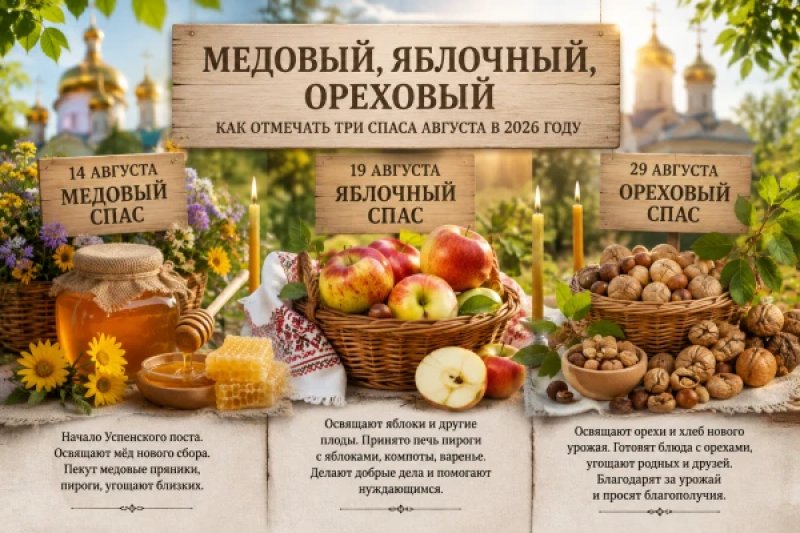
“In August, during the days of the Dormition Fast, there are holidays that are popularly called Spases. On August 14, the Feast of the Origin of the Honorable Wood of the Life-Giving Cross of the Lord is celebrated. On this day, honey is usually blessed in churches, which is why it is called the Honey Spas. On August 19, the Church celebrates the Transfiguration of the Lord. Traditionally, on this day, the fruits of the new harvest, primarily apples, are blessed, hence the popular name — Apple Spas,” said Archpriest Igor Podositnikov. The Dormition Fast lasts from August 14 to 27 inclusively. Therefore, the Honey (August 14) and Apple (August 19) Spases fall on fasting days, while the Nut Spas (August 29) is celebrated after the fast ends — on August 28, the Dormition of the Most Holy Theotokos is celebrated, when the fast is lifted. **Is it mandatory to bless apples and honey in church?** “Blessing the fruits is a good church tradition, in which a person thanks God for the harvest, for food, for earthly gifts. But it should not overshadow the holiday itself. On the Honey Spas, the main focus is not on honey, but on the Cross of Christ. On the Apple Spas, the main focus is not on apples, but on the Transfiguration of the Lord on Tabor, the revelation of His Divine glory. It is good to bring fruits to the church, but it is even more important to attend the service, pray, confess, and partake of the Eucharist if a person is prepared for it,” explained Igor Podositnikov. **Honey Spas — August 14** The first of the three Spases opens the series of August holidays. It is also popularly called the Wet Spas, the Spas on Water, the Poppy Spas, or the First Spas. The Honey Spas marks the beginning of the Dormition Fast — the shortest, but strictest fast. By mid-August, the honeycombs in the hives are filled with honey, and beekeepers begin to collect it. Traditionally, the new honey was brought to the church for blessing. It was believed that only after this could fresh honey be eaten. Honey gingerbread, pancakes, pies, and honey kvass appeared on the table. According to popular custom, the first spoonful of blessed honey was given to the youngest member of the family — “so that the children would be healthy.” Along with honey, water and poppy seeds were also blessed. **Apple Spas — August 19** The Apple Spas is the most famous of the three Spases, which is also called the Great Spas or the Spas on the Mountain. The Apple Spas coincides with one of the main Orthodox holidays — the Transfiguration of the Lord. On this day, the Gospel event is remembered when Jesus Christ revealed His divine nature to His disciples on Mount Tabor. The holiday is established in memory of the Transfiguration of the Lord before His three closest disciples — Peter, James, and John — shortly before His Passion. The custom of blessing fruits on this day appeared as early as the 8th century. Initially, grapes were brought to the churches, but in Russia, where grapes did not ripen everywhere, they were replaced with apples — hence the popular name. From this day, apple pies began to be baked, jams were made, and neighbors were treated. It was believed that it was from the Apple Spas that summer turned to autumn. Those observing the Dormition Fast were allowed to eat fish on this day. **Nut Spas — August 29** The third and final Spas, which is also called the Bread Spas, the Linen Spas, or simply the Third Spas. The holiday is timed to the Transfer of the Not-Made-By-Hands Image of the Lord. According to tradition, King Abgar of Edessa, who suffered from leprosy, heard about Jesus and sent an artist to Him. The Savior washed His face and wiped it with a towel (a cloth), and His Image miraculously appeared on it. The king, having applied it to himself, was healed. This event marked the beginning of the veneration of the Not-Made-By-Hands Spas. By this day, nuts (hazelnuts) ripen in the forests, and in Siberia, cedar cones. In churches, nuts, ears of wheat, and bread made from the new harvest flour were blessed. Housewives baked pies and loaves. The third name — the Linen Spas — is related to the fact that fairs were held on this day, where linen was sold. Since the Dormition Fast had already ended (the day before, on August 28, the Dormition was celebrated), the festive table on the Nut Spas could be particularly abundant and varied.