

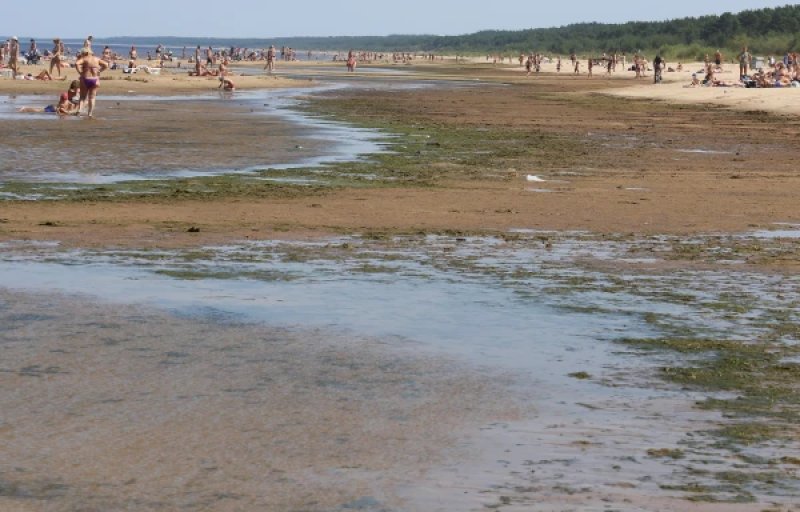
The beaches of Liepaja have once again been overwhelmed by seaweed this summer. Municipal services have already conducted large-scale cleanups three times, and the volume of removed mass has reached 11,000 cubic meters — approximately the amount usually collected over the entire season, reports [Latvian Radio](https://www.lsm.lv/raksts/zinas/latvija/10.08.2026-parbarota-jura-maina-algu-augsanas-apstaklus-liepaja-zalu-izvesanai-tere-arvien-vairak.a658037/). The last cleanup of seaweed took place in early August. Prior to that, cleaning was conducted at the end of June and before the Summer Sound festival at the end of July. For the city, the problem is becoming increasingly costly. Every year, more funds have to be allocated for seaweed cleanup, especially since Liepaja is obligated to maintain the cleanliness of its beach, which is marked with the international quality symbol "Blue Flag." After collection, the seaweed is not immediately removed. As explained by Aigars Štals, a representative of the Liepaja Municipal Administration, they are first piled on the shore to allow excess water to drain. "We pull them out of the water, rake them into piles, and let the water drain. Then the volume that needs to be transported becomes smaller," he explained. Some of the collected mass is stored at the Southern Mole, while the rest is taken to the outskirts of the city. At the same time, the municipality offers residents the opportunity to use the seaweed as fertilizer for free. To do this, it is enough to obtain permission and collect it from the beach themselves. Interest in this opportunity is growing: last year, 235 agreements were made, and over two years, their number has doubled. Authorities particularly hope for farmers. "After delivering grain or other products to the port, they can stop by here and pick up fertilizer for their fields," Štals noted. However, according to him, many mistakenly expect the municipality to organize transportation. "You need to come with your own transport, load it, and take it away yourself," he reminded. Scientists believe that the increase in seaweed is directly related to the eutrophication of the Baltic Sea — the excessive influx of nutrients into the water, often referred to as the "overfeeding" of the sea. Ingrida Andersone, a leading researcher at the Institute of Hydroecology, explains that due to the deterioration of water transparency, the conditions for seaweed growth are changing. Valuable furcellaria now grow much closer to the shore, which is why waves more frequently wash them onto the beaches. "Previously, we found them at a depth of 18–19 meters, but now they have moved to a depth of about 8–10 meters because water transparency is decreasing," the researcher said. According to her, the main ecological problem of the Baltic Sea remains the same — eutrophication. Despite the existence of river basin management plans, they are not actually mandatory. "Eutrophication continues and will only worsen. Nothing will change until the attitude towards this problem changes," Andersone emphasized. At the same time, scientists remind us that the discharge of seaweed onto the shore is a natural process. However, the change in their composition serves as an important signal about the state of the sea. While valuable species used to prevail, today, annual seaweeds characteristic of ecosystems with an excess of nutrients are spreading more frequently. This is why specialists believe that instead of simple removal, more attention should be paid to the processing of seaweed and their use in agriculture and horticulture. The growing volumes of seaweed washed ashore are becoming not only a municipal problem for Liepaja but also another sign of the deteriorating ecological state of the Baltic Sea.