

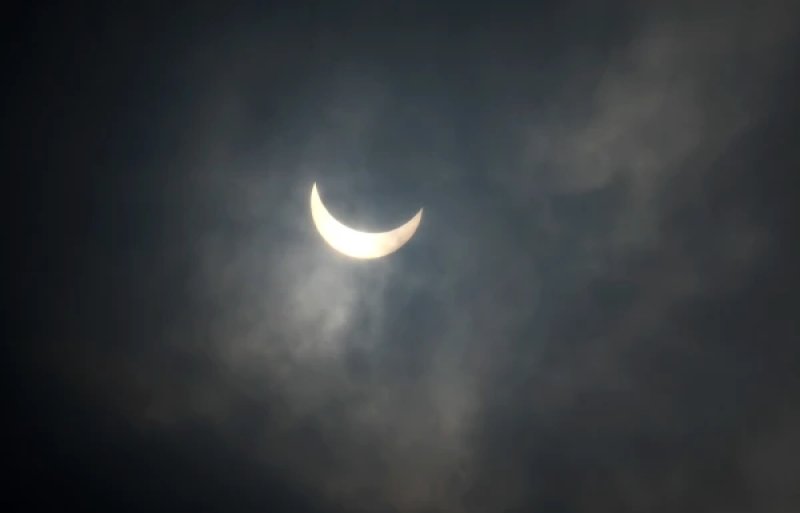
During the partial solar eclipse, which residents of Latvia will be able to see on Wednesday evening, variable cloudiness is expected. According to meteorologists' forecasts, there will be no completely overcast skies in any region of the country, but completely clear weather is also not anticipated. In some areas of central and eastern Latvia, brief rain showers are possible. In the evening, a light to moderate northwesterly wind will blow, with gusts reaching 13 meters per second along the coast of Vidzeme. The air temperature will range from +12 to +17 degrees, which is lower than the usual values for August. As the eclipse coincides with sunset, astronomers recommend choosing a location with an open view of the western horizon in advance. The best conditions for observation are usually found on the seaside or the shores of large lakes, where buildings and trees do not obstruct the view. The upcoming eclipse is considered one of the most significant in recent years. At its maximum phase, the Moon will cover up to 80% of the Sun's diameter, making the phenomenon easily noticeable even without special preparation—provided the weather is suitable. In Riga, the eclipse will begin at 20:06, reach its maximum phase at 20:57, and by 21:11, the partially covered Sun will disappear below the horizon. The picture will vary slightly in different parts of Latvia. In the eastern part of the country, the maximum phase will almost coincide with sunset, while in the west, about 20 minutes will pass between the greatest coverage of the solar disc and sunset. It is important to remember that observing the Sun without proper protection is dangerous. Looking at it with the naked eye or through binoculars and telescopes without certified solar filters is prohibited, as it can lead to irreversible vision damage. The safest method remains the use of special solar filters or projecting the image of the Sun onto a screen. If the cloud cover forecast holds true, residents in most regions of the country will have a good chance of seeing at least part of this rare astronomical phenomenon.