

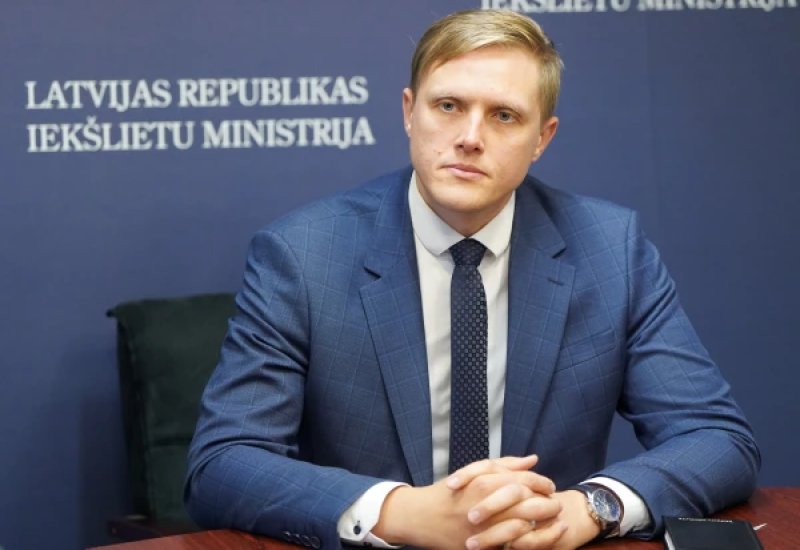
The letter was sent to the LETA agency by representatives of the Ministry of the Interior, indicating that the publication of the letter addressed to the Spanish Minister of the Interior on August 3 of this year was permitted in accordance with the decision of the Minister of the Interior. At the same time, ministry representatives noted that the letter should be viewed as internal correspondence between officials rather than as a communication material, and urged consideration of this context. In the letter, Dombrova criticized Spain's migration policy following the mass arrival of migrants in the Spanish North African enclave of Ceuta. The politician pointed out that Spain's decisions allegedly weakened the protection of the external border and created risks for the entire Schengen zone. "Spain's decision to legalize more than half a million people who are in the country without documents created a pull factor that was exploited by smuggling networks within a few days," Dombrova believes. An additional incentive for people to head to Spain, according to him, was also the "distorted and false" interpretation of the Spanish Supreme Court's decision of July 8. The Latvian Minister of the Interior also indicated that Spain cannot unilaterally weaken the protection of its external border and expect other EU countries to take on the consequences of such a policy without objections. In the letter, Dombrova also touched upon the solidarity mechanism of the EU Pact on Migration and Asylum. He questions whether Spain should receive financial, personnel assistance, or support in resettlement from other member states if it is recognized as a country under migration pressure. Dombrova writes that it would be difficult for Latvia and other countries located on the external border of the EU to accept the use of the solidarity mechanism in a situation where political and legal decisions made by Spain itself, in his assessment, significantly contributed to the emergence of the crisis. "Solidarity was created as a counterbalance to strict national responsibility, not as an insurance policy against the consequences of one's own political decisions," emphasizes Dombrova. Dombrova also points out that after the events in Ceuta, there was no coordinated European response, citing Italy's actions and the increased border control by France as examples. The Latvian minister also calls for an assessment of whether the Moroccan authorities facilitated the coordinated mobilization of migrants towards Ceuta or allowed it. If a third country uses migrants as a tool to exert pressure on any EU member state, in Dombrova's opinion, this should be viewed as a hybrid attack on the entire EU. In the letter, such possible actions are compared to the instrumentalization of migration at the borders of Latvia and other EU member states carried out by Belarus. Dombrova points out that the EU should not apply different standards in the east and south. At the same time, the Latvian minister suggested that Spain take advantage of Latvia's experience in border protection. Latvia would be ready to assist with personnel, procedures, and technical consultations, including in Ceuta and Melilla, according to his letter. Dombrova emphasizes in the letter that the events in Ceuta are no longer exclusively a bilateral issue between Spain and Morocco, but affect the entire Schengen zone and the reliability of the EU's external border protection system. As reported, unofficial information available to Latvian Television (LTV) from reliable sources indicates that the Spanish side expressed disappointment with the letter from the Latvian Minister of the Interior. The tone of the letter was deemed arrogant, and behind closed doors, Spain indicated that while its military personnel protect Latvia, Latvia prefers to attack Spain at a time when the Spaniards themselves are under pressure from immigrants. In turn, Prime Minister Andris Kulbergs (NA) remarked to the Minister of the Interior, indicating that in the future, communication with foreign states should be coordinated with the Ministry of Foreign Affairs, LTV reported. Meanwhile, President Edgars Rinkēvičs emphasized to journalists last week that the issue of the letter from the Spanish Minister of the Interior should be considered closed. Rinkēvičs reminded that without special authorization, Latvia in foreign policy is represented by three officials — the president, the prime minister, and the minister of foreign affairs. He acknowledged that there are many issues that require prompt responses, but he assessed the cooperation mechanism established between the president's institution, the Saeima, and the Cabinet of Ministers as good. The president reported that the prime minister had a conversation with the Minister of the Interior and, in his opinion, future policy will be more coordinated. He also noted that the letter from the Minister of the Interior can be viewed both from a foreign policy perspective and as an issue of sectoral policy, as EU internal affairs are coordinated. "I want to assure that Latvia is in solidarity with Spain. Politically, we are ready to help in every possible way. We are grateful to Spain for the participation of its military personnel in the multinational NATO brigade in Latvia," said Rinkēvičs. Several weeks ago, illegal immigrants arrived en masse in the Spanish North African enclave of Ceuta. Spanish Interior Minister Fernando Grande-Marlaska stated that 72,000 illegal immigrants entered Ceuta — a city with a population of 85,000. At least 72 migrants died while attempting to enter Ceuta. Since then, most of them have left Ceuta and returned to Morocco; however, the incident has caused tension in relations between Madrid and several other European partners.
