

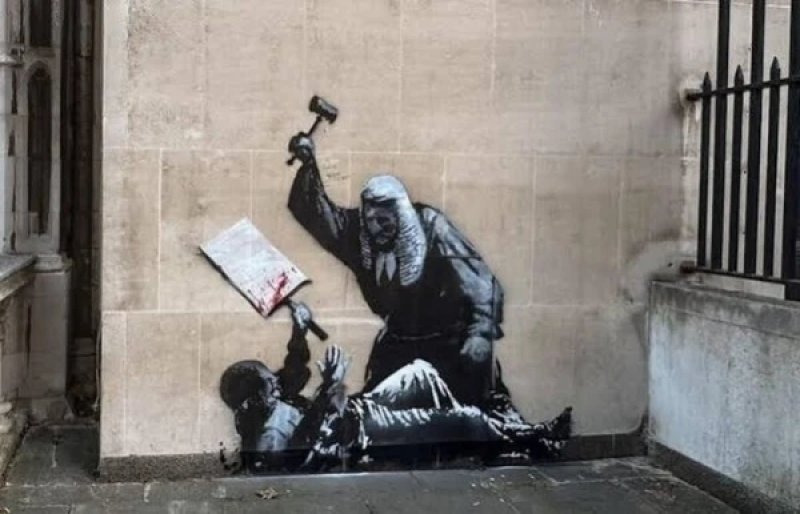
As noted by British media, the final amount may turn out to be even higher, as some of Banksy's works proved significantly more difficult to remove than anticipated. The most expensive piece was the one that appeared in September 2025 on the building of the Royal Court in London. It depicts a judge in a traditional wig raising a gavel over a protester holding a blood-stained placard. Since the building is a listed monument and protected by the state, authorities had to restore the original appearance of the facade. According to the UK Ministry of Justice, around £50,000 was spent directly on attempts to remove the artwork. Another £35,000 was spent on increasing security and paying for overtime for security staff. However, conventional methods of cleaning the wall did not yield the desired results. Specialists are now using more expensive laser technologies. If these also prove ineffective, damaged elements of the masonry may need to be completely replaced, leading to further costs. Westminster City Council spent nearly £60,000 after another Banksy work appeared at Waterloo Place near Trafalgar Square. The installation depicted a person with a flag covering their face. After the art object appeared, the location began attracting many passersby and fans of the artist. Authorities had to install protective barriers, organize round-the-clock security, and carry out necessary administrative procedures. Another unusual Banksy work appeared in August 2024 in the City of London. The artist transformed an old police booth into a kind of "aquarium," depicting a school of piranhas on its surface. The structure was subsequently dismantled. These works cost about £2,200. However, unlike previous cases, this piece was decided to be preserved: it is planned to be presented to the public at the London Museum. The expenses related to Banksy's works have once again sparked a debate in the UK about the line between street art and vandalism. Critics are outraged that tens of thousands of pounds from the budget have to be allocated to address the consequences of the artist's actions on public and historic buildings. Banksy’s defenders, on the other hand, note that his works transform urban spaces into open art venues, attract thousands of people, and provoke public discussions. Therefore, the question of what to do with the next unexpectedly appeared work of the artist—whether to preserve it or remove it—remains far from simple for British authorities.
