

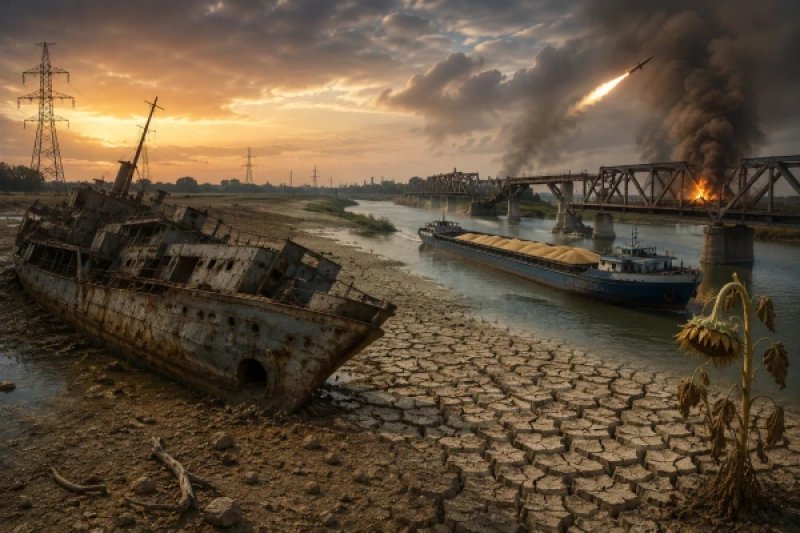
The Danube is once again literally bringing to the surface European military history due to drought. Near the Serbian port of Prahovo, the water level has dropped so significantly that the rusting hulls of German warships have emerged from the river. Up to 200 vessels were sunk here in September 1944 when German troops retreated under the pressure of the Soviet army. Eight decades later, the Danube has regained strategic importance due to the war in Europe. As Russian attacks make the use of Ukrainian Black Sea ports too dangerous, the river becomes one of the alternative routes through which Kyiv can export grain to the west. However, this summer, problems have arisen here as well. In Romania, the level and flow of water in the Danube have decreased so much that it has seriously hindered navigation and electricity production. ## Russia Intensifies Pressure on Ukrainian Ports At the same time, Russia has intensified strikes on port infrastructure in the Odessa region — the most important Black Sea city in southwestern Ukraine. According to data provided by the publication, in July alone, Ukraine recorded 35 attacks on vessels in ports, another 22 on ships at sea, and 67 strikes on port infrastructure. The infrastructure that supports the operation of alternative routes is also under attack. On August 9, Russian forces attacked a bridge in Mayaki, connecting the Odessa direction with routes towards Moldova and Romania. According to the Institute for the Study of War (ISW), one of the likely goals of the strike was to disrupt the land corridor, which is gaining particular significance against the backdrop of problems with maritime exports. ## An Unexpected Factor — Heat and Drought Newsweek notes that Russian President Vladimir Putin has gained an unexpected 'ally' — hotter and drier weather in Europe. Of course, Moscow cannot control this factor, and climate change does not always play in Russia's favor. However, the coincidence of the consequences of extreme weather with Russian strikes is becoming increasingly noticeable. Throughout the war, Ukraine has sought to create backup capabilities for vital systems. If a port was closed, cargo was redirected via alternative routes. After the destruction of energy facilities, the country increased electricity imports. The lack of precipitation in agriculture was compensated by irrigation. Now, extreme heat and drought are placing additional strain on these backup mechanisms — at a time when Russian strikes are forcing Ukraine to rely on them more heavily. ## Strikes on Infrastructure Have Continued Since 2022 The Russian campaign against Ukraine's critical infrastructure has been ongoing for several years. Large-scale strikes on the energy system began in the fall of 2022 when power plants and substations across the country were subjected to missile attacks. Subsequently, targets also included gas production facilities, ports, railway infrastructure, and bridges. Thus, this is a combination of two independent factors: targeted Russian attacks and extreme weather conditions that complicate the operation of those routes and systems designed to compensate for the consequences of destruction. Heat and drought are not advantages exclusively for Russia and can create problems on both sides of the conflict. However, for Ukraine, their consequences are particularly sensitive where they coincide with Russian strikes: the shallowing of the Danube complicates alternative exports, while extreme weather increases the burden on energy and agriculture. As a result, the backup systems that Kyiv relies on after damage to its main infrastructure are under additional pressure.
