

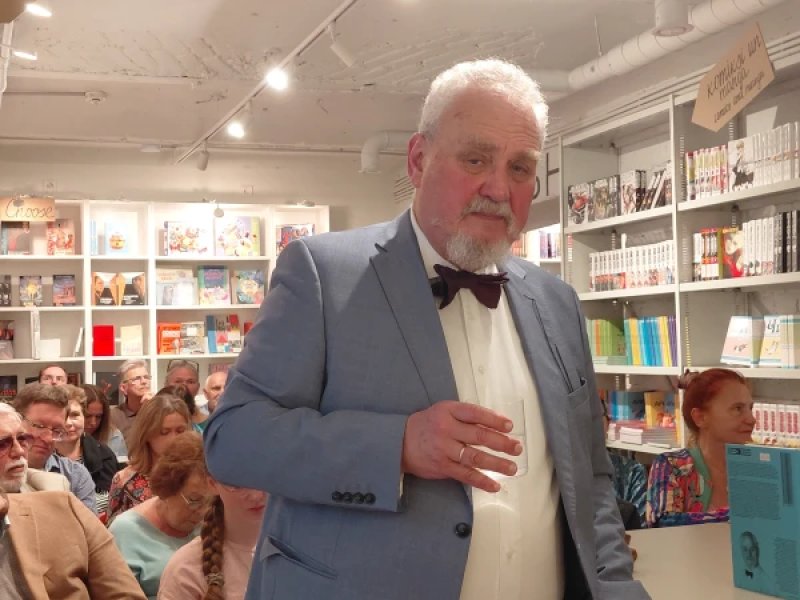
The publication of his 9-volume work on the history of his native country in the 19th century continues, with the 3rd and 4th volumes being released this year. This week, its author was a guest in Riga, and the topic of his conversation with our audience unexpectedly turned out to be... Bolshevism! ## Rejected Past and the Will of the Majority – I have gradually formed answers to the most important questions: why is everything happening this way now? Millions of people, historians, "Memorial" have spoken about the crimes of the past – yet the majority considers Stalin to be the greatest figure in the thousand-year history of Russia. The explanation, of course, is not in the organic stupidity of the Russian people. They are just like everyone else. Nostalgia for the Soviet past is not only a disease in the post-Soviet space. I taught in the Czech Republic for four years – and there they recall a reliable time when one did not have to fight for their existence. Why is Russia before 1917 considered some sort of under-history, while Brezhnev, Khrushchev, Lenin are "ours"? Something is wrong with the empire, but that empire was even larger. Stolypin, though with a mustache, a handsome man – but "not ours". The past before 1917 has been consciously rejected. When we think of France, England, Italy – there, family histories go far back into the past. In Russia, Ukraine, Kazakhstan, the memory of great-great-grandfathers is cut off. Or it is mythologized: my ancestors came from somewhere, perhaps with a crooked nose, maybe from the Caucasus? In reality, all of this has been rejected, like a first love, like a calling that we always remember while working as a clerk, an official, a businessman. Any person lives by their volitional choices, not just instincts. We want to eat, but we can either steal a loaf, earn money for it, or, as a last resort, beg for alms. Can we speak of the people this way? I think we can: this factor determines the fate of the people for a long time. During perestroika, the term was used – fateful choice. Therefore, I will formulate this as a telic choice, from the Greek word telos – will. It determines the stable psychological stereotypes of the people, from which their fate changes. Thus, the choice of the French people was the Great Revolution of 1789 and the Napoleonic Wars. This leaves a colossal imprint. But what happened during Louis XVI or Henry IV – that is for aesthetes. The same in Germany: the German people chose Nazism, chose the Holocaust. That was their choice, but in 50 years they made another telic choice and rejected their past. They said: yes, we did all this, and it is a huge crime. And therefore, reasonable politicians – Merz, Weizsäcker – speak of this as the greatest calamity. This allows the mode of the people to be preserved. The category of Christian repentance – metanoia – implies this. This is a rare case, but it exists in world history. ## "There is a word – slave" – In Russia, "La Marseillaise" also became an anthem, and then people sang "Who was nobody will become everybody." There was a total change of symbols. From old Russia, only borders remained, although the Bolsheviks wanted to conquer the whole world, for which they depicted a globe on the coat of arms. The Russian language was also attempted to be translated into Latin script; in the 1920s, entire institutes worked on this. And the old flag was absent – neither Poland nor Hungary dared to do this. There was a complete destruction of the old elite – even the Nazis did not dare to do this. Hitler, before he shot himself, was worried that he did not exterminate all those Stauffenbergs. Some, of course, changed their colors – like Alexei Tolstoy or Marshal Shaposhnikov. Here, in the Baltics, Germans were destroyed. In Central Asia – Russians, remember the Semirechye uprising? The main symbol, of course, is the murder of Nicholas II and his family. It is important to consider the people's attitude towards this. Here are the memories of a miracle survivor, who crossed the Sestra River, the former Prime Minister Kokovtsev: "I saw no sign of compassion anywhere..." The philosopher Fyodor Stepun on the Red Terror: "The Bolsheviks did it, but the people – approved...". The people did not defend, but why? Here I would like to recall the words of Arnold Toynbee from "A Study of History." I consider him my teacher. "It is clear that the ethnicity of these unfortunate people is woven from hatred; they are merciless to their executioners..." This is not about the Russian people. "The mask of civilization is torn from the human being." What happened in Russia – I have spoken about this many times. Everyone knows, of course – and these 4 volumes talk about serfdom, about slavery. A Russian historian living in America, Konchin, wrote a book "American Slavery and Russian Serfdom: A Comparison." There is, of course, no difference. There is a word: slave. He did not become a slave of his own will. And these are ordinary Russian people, just recently, during the Time of Troubles, who freed Russia from invaders. ## Unfulfilled Liberation – Catherine the Great, in her "Instruction to the Legislative Commission," explains that there are two types of slavery – personal and essential. The latter exists in the Czech Republic, Hungary, when peasants are forced to pay tribute. And personal should not exist. Then her very progressive advisors, like Count Panin, came to her and said: you should not write this, otherwise you will meet the fate of your husband. The Russian aristocrats themselves convinced the German queen that the slavery introduced by Peter the Great could not be abolished. And this happened more than once... And out of the entire huge commission, only 2 people spoke against serfdom – deputies Korobyin and Kozelsky. They were literally spat upon by the other gentlemen. The Cossack elder of Little Russia even in 1762 asked Catherine, who had just ascended the throne, about the serfdom of his peasants! Not Poles, but the most genuine Ukrainians. The Church owned millions of peasants and was not a good but a cruel master. Catherine transferred church peasants to state peasants, but then gradually allowed, for example, the acquisition of serfs by the white clergy. A protodeacon cannot plow the land himself – he needs slaves! ## "What Could Have Stopped the Revenge" – In any case, for the peasants, it was not about restoring freedom – but about revenge. When Alexander II freed the peasants – the main thing was not done. What could have stopped the revenge? Forgiveness for what was done to ancestors, fathers, and grandmothers. But not a single such word was said. Individual people, like Leo Nikolayevich Tolstoy, were considered oddballs. The old elite, the nobility, the lands – remained. The army, instead of being formed by conscription, began to be formed by draft; peasants received self-governance, but the main thing was not done. If you cheated on your wife – then the only way to get forgiveness is to lie at her feet! And, of course, the Church. There were individual priests who tried to protect the people. Now they talk – Putin, the Patriarch. But what about the Synod under Catherine? Even the old Metropolitan Philaret, Alexander told him: you write well, write a manifesto on the liberation of the peasants. But before – he was silent. Now in America, black people say: "Black lives matter." What do they want, there is freedom there?! And there, they were silent for a hundred years. That is why in Russia, destruction and expulsion occurred – to the applause of the people. That is why the old world was rejected to the ground, and there was a desire to build a new one. Since the old power was with God – in the new one, it became the Leader. As Toynbee said: "A collective form of idolatry." ## "It Was a People's Power by Election" – But who are these leaders? They are not Martians. Those we call revolutionaries, since the 19th century, dreamed not of liberating the people, but of coming to power. I mean, of course, not naive boys and girls, but the "head" of the Bolsheviks and Social Revolutionaries. Two-thirds of the Cheka were Russians, Ukrainians, Belarusians. The number of Jews was, of course, above the national average, twice as much; in 1921 – 9%, Latvians – 3.5%. But one thing united them all – only 1% had higher education. Such simple people. This was their power, the people's power. Gradually, they began to understand: the leaders are vile, they live for themselves. But – ours! Any person "from the plow" could make a fantastic career: the son of a shoemaker Stalin, a locksmith Khrushchev, a combine operator Gorbachev, and even a boy from the Urals Yeltsin... What did he do when he was the first secretary of the Sverdlovsk regional party committee? We violated the convention on the prohibition of biological weapons, and he covered it up. The Bolsheviks gave everyone a chance – while the serf peasant had a negligible chance. There was a special decree not to accept the children of serfs into either gymnasiums or universities. God gave the opportunity to count. He knows how many Germans voted for Hitler. And do you know how many voted in the elections to the Constituent Assembly for the parties that wanted to destroy the old elite? The Social Revolutionaries and the Bolsheviks – with a turnout of 62%, respectively 59% and 23%. Together – an overwhelming majority of the population. For the Mensheviks – socialists, but democrats, only 2% voted. For all religious Orthodox parties – 0.5%. In the most Christian Russia. "We have a sufficiently idealized image of the Social Revolutionaries, but they are just as much terrorists as the Islamists in Israel or those who blew up the Twin Towers." ## "Putin Says – Everyone Contributes to the Common Fund" – The power was bandit-like, mafia-like, but – its own. It really was a workers' and peasants' government, with a very small percentage of intelligentsia. At first, there were many non-Russians, but Stalin removed them all – only Russians, Ukrainians, Belarusians remained, and others were taken in very small doses. The nomenclature did not turn into a caste. It was important for them that private wealth did not accumulate. They abandoned the market because officials did not own property. The trouble is that this system was stable but ineffective. However, Russia helped the same GDR, giving it oil, which was then sold to the West, on which elite groups existed. As soon as the market began under Gorbachev – a new elite emerged, new rich people. Society became ossified. The Chekist power – it is already hereditary. The Patrushevs, Bortnikovs, they do not want to give up their property. Putin says: everything to the common fund, for the war! This old nobility limited itself. The normal transmission of family, faith was interrupted. A new society has been formed, eager to subjugate others. I am the boss – you are a fool. Now, friends, in this situation, our people face a new choice. To choose something positive, we must understand that we – our fathers, including myself – made a criminal choice in 1917. We should have taken a completely different path: to build a new, popular society, as they do in England, in Sweden. In his Nobel speech, Gorbachev said that "we must take only the truth into the future." This was June 1991. But the whole trouble of Mikhail Sergeyevich Gorbachev is that he wanted to build his reforms on "good Lenin." But there is no good Lenin. We must, through the awareness of mistakes, see the path of changing the mind. And build not a pseudo-tsarist, pseudo-Bolshevik, pseudo-market policy. Now, in Ukraine, some town is conquered – and immediately it is returned to its communist name. Not Lyman, but Red Lyman. And others have their own history dumped on the Russians, which is very convenient. In Riga, there is a monument to the riflemen, in Ventspils – to Fabrichius, with those terrible mustaches. But I do not teach other peoples; I have enough of my own. In Russia, no one speaks of restitution – any idea about it causes enormous rejection. All property was private. All this is lost, and people remember it as a joke: here, my grandfather had land near Torzhok, and he was dispossessed. Here, in the Baltics, foreign power occupied, so they dreamed of independence and property. But in the states that were in the USSR since 1922 – this idea is dead. And in Central Asia, and in Armenia. There is no such thing as a person coming from abroad to Yerevan and receiving property. Because our ancestors connected themselves with this crime! And this is a factor of volitional continuity – it acts. Although, when the conversation here begins about German property before 1918 – the same mechanism starts to work. Just like in Poland – about Jewish property. Putin is just a simple Soviet man, a KGB officer. Look what he has brought – the whole world is on edge: a real war – in Ukraine, a hybrid one – all over the world. And the foundation is in his grandfather, who was a cook for Lenin. Putin loves Stalin very much. His relationship with Lenin is a bit more complicated; there – Ukraine... But he lies in Red Square, and no one removes him. I know that many colleagues from "Memorial" will be upset with me. But "Memorial" very often recalled the victims of the 1930s, but not Lenin's. Because the grandfathers of the "memorialists" themselves committed repressions. It should have been done differently. That is why I write my books, record my lectures, while I still have the strength.
