

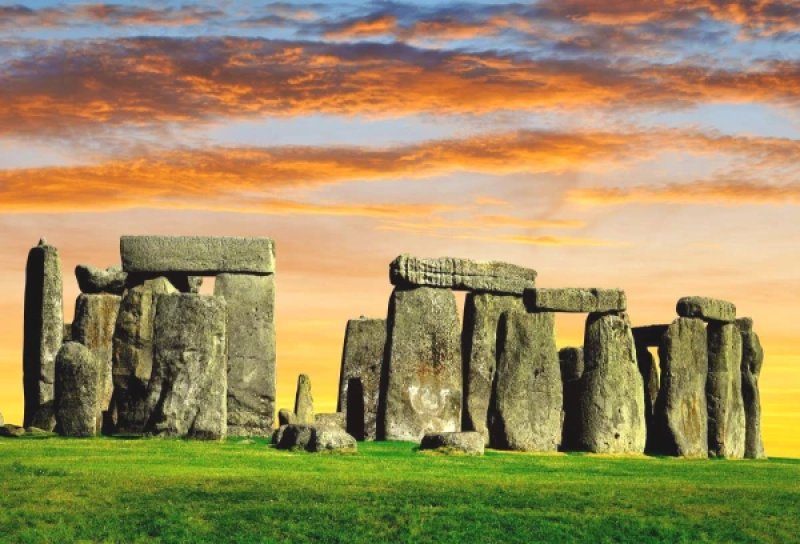
## Scientists have discovered how the six-ton Stonehenge stone traveled 700 kilometers The results of the work of an international group of researchers have been published in the scientific [Journal of Quaternary Science](https://onlinelibrary.wiley.com/doi/10.1002/jqs.70080?utm_source=chatgpt.com). The findings were also reported by [Curtin University](https://www.curtin.edu.au/news/media-release/study-details-epic-transportation-of-stonehenge-stone-across-ancient-britain/?utm_source=chatgpt.com) and [ScienceDaily](https://www.sciencedaily.com/releases/2026/06/260608040003.htm?utm_source=chatgpt.com). ### The Mysterious Stone from Scotland The altar stone is one of the largest monoliths of Stonehenge. It is a flat block of sandstone about five meters long and weighing approximately six tons, located in the central part of the famous prehistoric structure. It was previously believed that the stone might have originated from Wales, from where some other stones of Stonehenge were delivered. However, studies conducted in recent years have shown a completely different picture: the geological characteristics of the Altar stone indicate its origin from the Orkney Basin in northeastern Scotland. Thus, the stone ended up about **700 kilometers in a straight line** from its region of origin. This raised a new question for archaeologists: how could people of the Neolithic era move such a heavy block across a significant part of Britain? ### The Glacier Could Have Helped, But Did Not Deliver the Stone to Stonehenge The authors of the new study decided to test one of the alternative hypotheses: perhaps the massive boulder was initially transported by a glacier, and ancient people only had to cover a relatively short distance. To do this, the scientists combined geological analysis with computer modeling of the last British-Irish Ice Sheet's movement. The researchers calculated where the ice could have transported rock fragments from various areas of northeastern Scotland. The modeling showed that glaciers were indeed capable of moving such rocks over significant distances. In some scenarios, the stones could have ended up far to the east — even reaching the Dogger Bank area in the North Sea. However, the main result necessary for the "glacial" version of the Altar stone's origin was not obtained: the model does not show a natural path by which the ice could have delivered such a boulder directly to the Salisbury Plain, where Stonehenge is located. ### The Huge Boulder Was Likely Transported by People The researchers do not rule out that the glacier could have done part of the work and initially moved the stone from its geological origin. However, at a certain stage, the transportation of the six-ton boulder still had to be handled by people. Even in the most favorable "glacial" scenario, the monolith would have to be transported over a very long distance. This makes the Altar stone evidence of much more advanced transportation capabilities of Neolithic society than one might assume. The researchers consider several possible options. The stone could have been moved overland, using natural corridors and elevations. It is also possible that a combination of land transportation and movement by water was used. However, the exact route remains unknown for now. ### Stonehenge Connected Different Regions of Britain The discovery is significant not only for geology. If people really transported the massive stone from Scotland to southern England, it indicates the existence of long-distance connections between Neolithic communities in Britain. Moving the six-ton monolith hundreds of kilometers required serious organization: a large number of people, knowledge of the terrain, route planning, and likely cooperation between various communities. Therefore, the researchers view the Altar stone not just as a building material but as possible evidence of social and cultural contacts between distant regions of the island. ### The Exact Origin of the Stone Still Needs to Be Determined Scientists intend to continue searching for the exact place of origin of the Altar stone in northeastern Scotland. A more precise geological "pinpointing" may help reconstruct the most likely path of its journey to Stonehenge. The new study strengthens the version that the appearance of the Altar stone at Stonehenge was primarily the result of human activity, rather than random work of a glacier. If the six-ton monolith was indeed transported from northeastern Scotland, its journey of hundreds of kilometers can be considered one of the most impressive engineering achievements of Neolithic Britain.
