

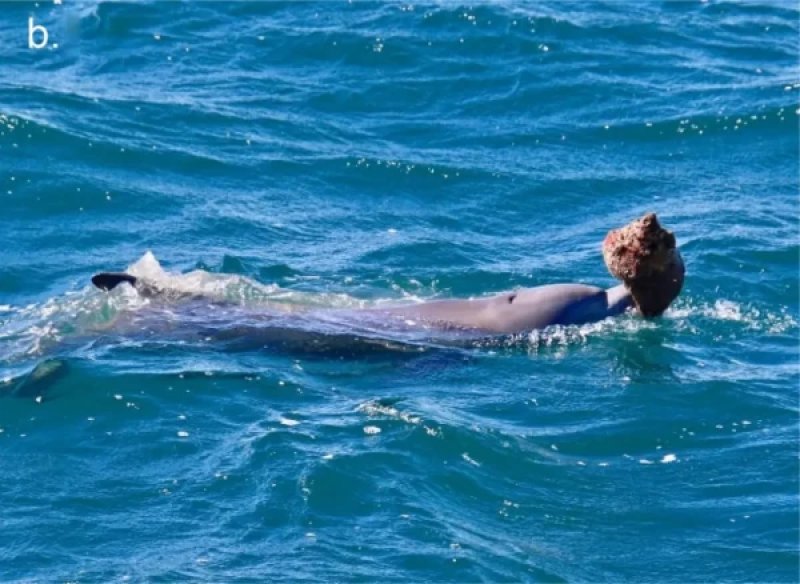
The unusual behavior of Pacific bottlenose dolphins was recorded near Hervey Bay on the eastern coast of Australia. The results of the study were published in the scientific journal Marine Mammal Science. The lead author of the study, biologist and marine mammal specialist from the University of Sunshine Coast, Alexis Levengood, stated that she was on a research vessel with students when she noticed a female dolphin with a large shell.  _Photo: University of Sunshine Coast._ The researcher immediately realized what kind of behavior the team was witnessing. Dolphins employ a technique known as shelling: they herd fish into an empty shell of a large sea snail, after which the dolphin brings it to the surface and extracts the prey that has ended up inside. In the footage taken in 2025, a dolphin can be seen surfacing with a shell, manipulating it, and then attempting to catch the fish that has escaped from it. Levengood admitted that what she saw evoked such strong emotions in her that she began to shout with excitement to the students nearby. She was particularly struck by the fact that this behavior was recorded specifically off the eastern coast of Australia. The technique was not entirely unknown to scientists. As early as 2013, dolphins using shells during hunting were observed in Shark Bay on the western coast of Australia. However, researchers have now managed to obtain video evidence of such behavior in another population living thousands of kilometers away. An even more important observation was made when scientists saw an adult female with a calf. The mother surfaced with a shell from which a fish slipped out. The adult dolphin left the shell and chased after the prey. A few minutes later, the calf picked up the same shell and began to hold it almost exactly as the mother had done before. Researchers do not yet claim that the young dolphin has learned to successfully catch fish in this way on its own. However, its actions may represent the first potential evidence that this hunting technique is passed from mother to offspring. This type of learning is called maternal social transmission: the calf acquires a certain skill by observing the behavior of its mother and mimicking her actions. This raises a new question for scientists — how such an unusual technique spreads among dolphins and why similar behavior is observed in populations separated by thousands of kilometers. One hypothesis is that dolphins on the western and eastern coasts of Australia independently developed the same hunting method. There is another explanation. Other groups of dolphins that also use shells may exist between the two known populations, but scientists have simply not yet recorded such behavior. According to Levengood, it cannot be ruled out that there are populations in northern Australia that possess the same technique. Further observations will help determine how widespread it is. For researchers, such discoveries are important not only as further evidence of the high intelligence of dolphins. The use of objects to solve specific tasks is considered one of the most interesting manifestations of complex animal behavior. The ability to pass acquired skills to the next generations is particularly significant. If further research confirms that calves indeed learn to use shells from their mothers, it will provide additional evidence of the existence of behavioral traditions in dolphins that can be compared to elements of culture. Studying such abilities may help scientists better understand human evolution. By observing how other animals master tools and pass this knowledge to their offspring, researchers gain the opportunity to trace the conditions under which complex forms of learning and tool use arise during evolution. The authors of the study believe that the new footage once again demonstrates the ingenuity and adaptability of dolphins to their environment. Now scientists need to find out how widespread the unusual hunting with shells is and whether mothers intentionally pass this skill on to their calves.
