

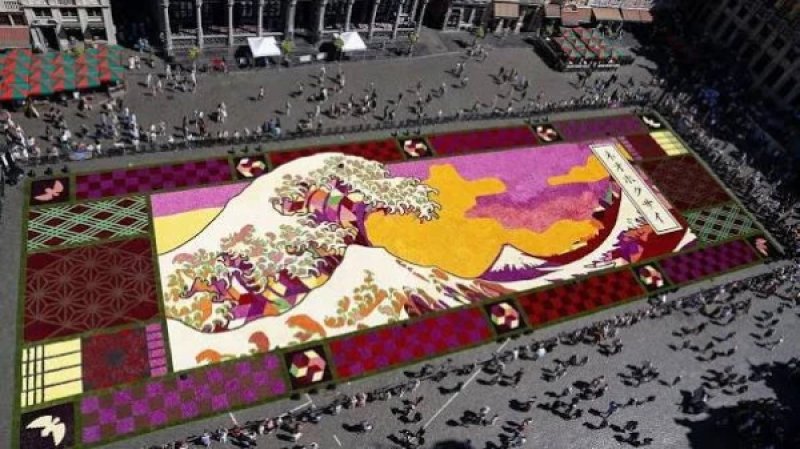
The floral composition occupies almost the entire central part of the Grand Place. Its length is 70 meters, width is 24 meters, and the total area reaches approximately 1,680 square meters. The project was created by Japanese artist Hiro Sugiyama. More than 700,000 flowers were needed to create the enormous image. The base of the carpet consisted of Belgian dahlias, complemented by begonias, grass, and bark. Over 100 volunteers worked on bringing the sketch to life. They spent about six hours placing hundreds of thousands of flowers in a strictly defined order, transforming the square into a massive image reminiscent of Hokusai's famous wave. The Japanese ambassador to Belgium, Takeshi Osuga, also joined in creating the composition. The floral carpet looks particularly stunning after dark. In the evenings, the composition becomes part of a light and music show: the design on the square is enhanced by special lighting and musical accompaniment. The theme of the Flower Carpet in 2026 is the 160th anniversary of the establishment of diplomatic relations between Belgium and Japan. This year's floral carpet is the 24th in the history of the project and the second dedicated to Japanese themes. Brussels and Tokyo first collaborated on a composition for the Grand Place in 2016. The tradition of decorating the famous Brussels square with enormous compositions of live flowers began more than half a century ago. The first floral carpet on the Grand Place was created in 1971, and since 1986, the event has been held every two years in August. The Flower Carpet is considered an example of ephemeral art: creating the enormous composition takes hundreds of thousands of flowers and hours of meticulous work, yet the artwork exists for only a few days. This transience has become one of the hallmarks of the Brussels tradition — the giant floral design can only be seen for a short period before it completely disappears.
