

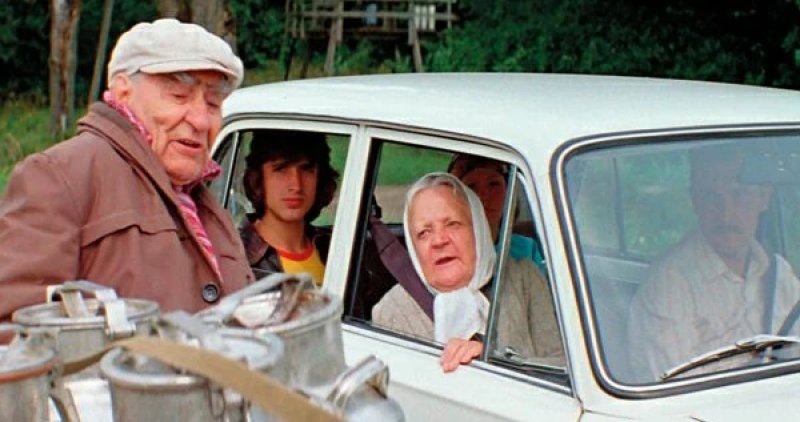
 Foto: BB.LV / Кадр из латышского кино
Although the stated goal of the amendments is to strengthen the position of the Latvian language, their real consequences may be the opposite. According to industry representatives, the changes will weaken Latvian media, complicate the screening of Latvian films, and further push the audience towards foreign television channels and global streaming platforms. This approach, the authors of the statement believe, effectively lobbies for the interests of foreign media. The absurdity of the proposed changes, according to industry representatives, is particularly evident in examples from Latvian cinema. In many films, the use of other languages is a conscious directorial decision and is necessary for an authentic depiction of a specific character, era, or historical situation. For example, in the film "Limousine of the White Nights," the famous phrases of Aunt Mirta in Russian are an integral part of her character and the atmosphere of the film. The proposed regulation would mean that when the film is shown on television, these phrases would have to be voiced or dubbed into Latvian. This would not make the film more Latvian. But it would change the film itself. Similar situations arise in newer Latvian films, including "Tīklā. TTT leģendas dzimšana" and "Uļa," where the use of the Russian language is necessary to convey the historical context, era, and character traits. Another serious problem is that the new requirements will apply only to television channels under Latvian jurisdiction, but not to media service providers registered in other EU countries that offer their content to the Latvian audience. Thus, Latvian legislators are creating worse competitive conditions for local media than for their foreign competitors. As a result, the regulation, which is supposedly intended to strengthen the information space of Latvia, actually gives competitive advantages to foreign media. If Latvian television channels lose their audience, they also lose advertising revenue, and along with it, the ability to invest in the creation of local Latvian content. There is also a copyright issue. A film or series is, in most cases, not material created by the television channel itself and which it can change at its discretion. An audiovisual work is subject to copyright, and the right to show it is acquired under specific licensing terms. The rights holder may, for artistic reasons, not allow the translation, voiceover, or dubbing of a fragment into a foreign language or an episode that is intentionally created in two or more languages. Therefore, in some cases, the proposed regulation may put television channels in a situation where the law requires them to take an action for which they do not have the necessary rights. A practical solution in such a case would be very simple - not to show the film at all. And the Latvian viewer would suffer from this. At the same time, the content itself will not disappear for viewers. It will remain available on foreign-registered television channels, Netflix, and other platforms, to which the requirements set for Latvian television channels will not apply. "The Latvian language and the information space of Latvia cannot be strengthened at the expense of weakening Latvian media. A situation cannot be created where Latvian films are harder to show on Latvian television channels than on foreign platforms," the statement reads. Latvian public media, the Latvian Association of Film Producers, and the Latvian Association of Broadcasting Organizations urge the Saeima not to adopt such regulation in the pre-election rush and to fully assess its impact on the competitiveness of Latvian media, the availability of cinema, viewer habits, and the safety of the information space before further advancement. Industry representatives are calling to stop this legislative "marriage" and not to support the amendments in the third reading.
