

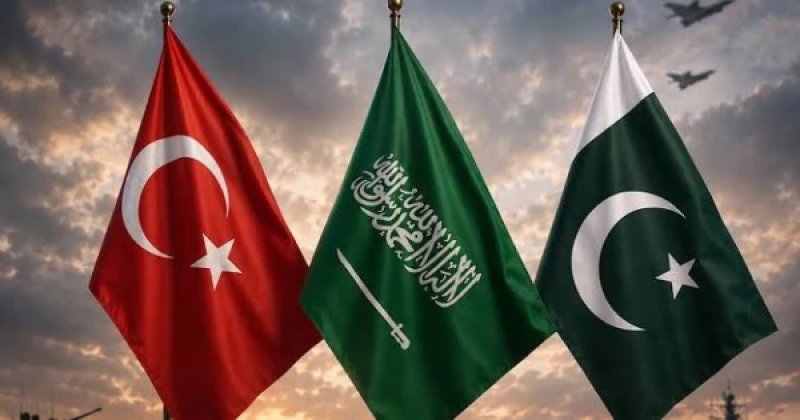
 Foto: BB.LV / Мусульманское НАТО
Some have interpreted this as a signal to countries like Iran and Israel. Others believe it reflects the countries' desire to reduce their dependence on the U.S. for security matters. However, since the full text of the agreement has not yet been made public, there is plenty of speculation: critics of the agreement argue that the national interests of these three countries, which are not connected by land borders, do not align. Some experts also note that the lack of a published text raises serious questions — particularly regarding its deterrent effect. What do we know about this pact — and how has it been perceived? **'Muslim NATO'?** According to the agreement, an attack on one of these three countries will be considered an attack on all three. Turkey's Foreign Minister Hakan Fidan characterized this commitment as "technically analogous" to Article 5 of the NATO Charter — the collective defense provision. However, until it is tested in practice — for example, in the case of Pakistan and Turkey's response to any attack on Saudi Arabia — analysts believe that this pact should be viewed more as a "declaration of intent" rather than a commitment in the style of the North Atlantic Alliance. Professor Serhat Güvenç from Kadir Has University’s Department of International Relations notes that "until we see the text of the agreement, the question of how it will be implemented remains a matter of speculation." Güvenç points out that, unlike NATO, where the U.S. has long dominated in terms of funding and armaments, this pact represents an "alliance of equals." "There are both positive and negative aspects to this," he says, "as all decisions will be made through negotiation, and in many respects, the countries will prioritize their own national sovereignty." Alison Mainor from the Atlantic Council agrees. In an interview with the BBC World Service in Urdu, she stated that, "given the changing and sometimes diverging interests and strategies of these three countries, it is unlikely that this alliance will be able to provide a comprehensive and fully integrated military response to various crises, as NATO does." The question of whether it can evolve into a reliable military alliance in the future remains clearly open. **Who Will Benefit the Most?** Saudi Arabia is a major power with a large economy, possessing financial resources, diplomatic influence, and oil, but the kingdom is concerned about the growing threats it currently faces: Iranian missiles and drones, Houthi attacks, and disruptions in key maritime routes. Turkey is a NATO member, has one of the largest armies, and seeks to act as a bridge — both geographically and diplomatically — between the alliance and Middle Eastern countries. It sees potential for new opportunities in defense exports and production. Pakistan also represents a fairly autonomous military power and is the only participant in the agreement that possesses nuclear weapons. According to Alison Mainor from the Atlantic Council, the greatest benefit may be collective. She notes that this partnership provides all three countries with the opportunity to send a strong political signal, enhance their diplomatic weight, and gain strategic advantages, the BBC reports.
