

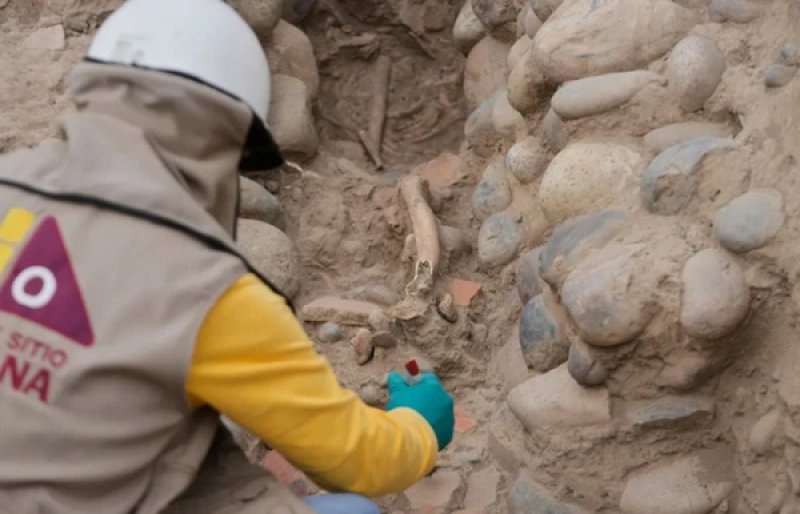
The remains were discovered during scheduled archaeological work at the site of Huaca Puccllana — one of the most important pre-Hispanic monuments in Lima. This vast complex, primarily built from adobe bricks, is now situated right among modern urban neighborhoods. As the head of the archaeological expedition, Gladys Paz, explained, the skeleton was located inside an ancient channel that was once connected to a ceremonial pool. The individual was lying on their left side, with their face turned toward the pyramid and the Pacific Ocean. The positioning of the remains led specialists to suggest that this was not an ordinary burial. Most likely, the person was intentionally placed in the channel as part of a special ritual associated with the cessation of use of this structure. Preliminary estimates suggest that the burial dates back to around 650 AD — a period of the Lima culture's flourishing, which existed long before the rise of the Inca Empire. Representatives of this culture inhabited the areas along the arid central coast of present-day Peru, and Huaca Puccllana was one of their key administrative and religious centers. Today, the ancient pyramid is literally embedded in the modern metropolis. The archaeological complex is located among the prestigious neighborhoods of Miraflores and San Isidro, next to residential buildings, parks, and restaurants. Additional questions have arisen for scientists regarding the structure of the ceremonial building near which the remains were found. Most of the constructions at Huaca Puccllana were built from the small adobe bricks characteristic of the Lima culture. However, this particular object was constructed from river stones. Archaeologists believe that the use of an unusual building material for the complex may have been related to the special purpose of the structure and the significance of the ceremonies conducted there. The remains are well-preserved, so specialists hope to gain new information not only about the cause of the individual's death but also about how they lived. Anthropological studies should help more accurately determine their sex, age, health status, and possible injuries. In the coming months, scientists will also need to verify the main hypothesis — whether the individual discovered was indeed a ritual sacrifice. The results of the studies may help better understand the religious beliefs of the Lima culture and the rites that accompanied the closure or cessation of use of cult structures. Archaeological finds are not uncommon for the Peruvian capital. According to the Ministry of Culture of Peru, modern Lima is located in an area where hundreds of ancient monuments have been preserved. Traces of former civilizations are even found during construction work and the laying of urban communications. However, the discovery near Huaca Puccllana is considered particularly interesting by specialists. It may provide new insights into the rituals and social life of the people who inhabited the central coast of Peru many centuries before the arrival of the Incas and Spanish conquerors.
