

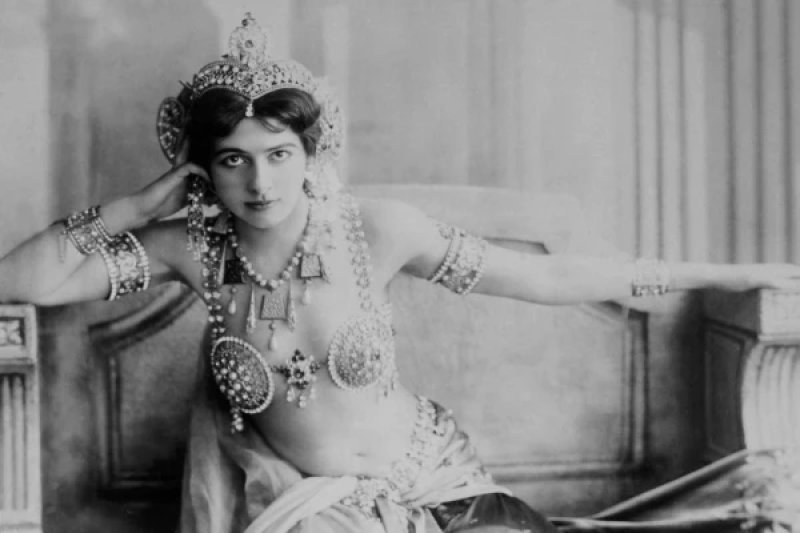
Mata Hari managed to create the image of a mysterious and independent woman that outlived her. She turned her own biography into a legend, and the ability to make an impression into almost a profession. Some techniques that attracted the attention of those around her are quite recognizable even today. ### Confidence is More Important Than Perfect Appearance Mata Hari did not try to conform to the beauty standards of her time. Her appearance and figure differed from the ideals of the day, and true success came to her after the age of 30. However, instead of worrying about imperfections, she learned to present what she had in an impressive way. She carried herself as if she never doubted her own attractiveness for a second. This confidence largely created the aura of a femme fatale around her. Her example shows that the impression a person makes on others depends not only on appearance. The way one holds oneself, voice, gaze, posture, and internal sense of self-worth can prove to be much stronger than flawless facial features. ### The Body Should Speak Without Words Mata Hari did not possess the technique of a professional dancer, and her contemporaries noted this repeatedly. However, she understood perfectly how to attract and hold the audience's attention. A turn of the head, a movement of the hand, a pause, a gaze — everything became part of the performance. Her performances were built not so much on openness as on anticipation and unsaid words. She intuitively understood one of the main principles of seduction: imagination often works stronger than what is shown directly to a person. Therefore, it was not a single gesture that mattered, but the anticipation of the next one. ### Leave Room for Mystery Mata Hari invented a significant part of her own biography. She told exotic stories about her origins, childhood, and acquaintance with Eastern culture. The truth intertwined whimsically with fantasy, and over time it became increasingly difficult to separate one from the other. But this is what worked for the image she created. Those around her could never be completely sure of who this woman really was. Mata Hari left space for imagination. The interlocutor received a few details, while the rest of the story was involuntarily filled in by themselves. As a result, the mystery only heightened interest. Of course, building relationships on a fabricated biography is a questionable strategy. But another principle is quite universal: a person does not have to tell everything about themselves right away. Some ambiguity can sustain interest much longer than complete openness in the first hours of acquaintance. ### Intelligence Can Also Seduce The image of Mata Hari is often reduced to that of an exotic dancer and courtesan. However, mere striking appearance would hardly have been enough to remain interesting to people in the upper echelons of European society for years. She read, was interested in the culture and customs of other countries, knew how to engage in conversation, and listened attentively to her interlocutor. Her experience of living in the Dutch East Indies also provided her with topics that seemed unusual and exotic to Europeans. Mata Hari understood that one could attract attention with appearance, but holding it was significantly more challenging. The ability to converse, listen, ask questions, and remember details turned a brief acquaintance into an emotional connection. People particularly enjoy feeling that they are truly being heard. And this principle of human communication has hardly changed over the century. ### Don’t Be Afraid to Be Different from Others In the society of the early 20th century, female sexuality was surrounded by numerous taboos. Mata Hari did the exact opposite of what conservative audiences expected from a woman. She created exotic stage numbers, used revealing costumes, and turned dance into a carefully staged performance. At the same time, she presented what was happening not as something shameful, but as art. It was her ability to break conventional rules that made her famous. In everyday life, this principle can be understood much more broadly. Trying to please everyone usually makes a person unnoticed. Individuality, on the contrary, implies the risk of not pleasing someone — but it is precisely this that allows one to be remembered by those who are truly interested. ### Create Your Own Image Today, this would be called a personal brand. Mata Hari was engaged in it long before the very concept emerged. She carefully thought out her clothing, jewelry, manner of appearing in public, and the stories she told about herself. Eastern motifs emphasized her exotic image and allowed her to stand out instantly among those around her. Even a regular appearance in a restaurant or theater could turn into a small performance. People should talk about her after she left. This was one of Mata Hari’s strongest qualities: she did not allow those around her to accidentally decide how she would be remembered. She constructed her own image herself. Today, theatrical costumes are not at all necessary for this. It is more about understanding one’s strengths and the ability to consistently emphasize them — in appearance, behavior, and communication. ### Don’t Make a Man the Center of Your Life Perhaps this principle sounds the most modern. After a difficult marriage, Mata Hari sought to maintain her independence. She had many wealthy admirers from whom she accepted gifts, money, and assistance. But she tried not to tie her entire life to one man. Such distance only enhanced her attractiveness. Admirers understood that being near her did not mean possessing her. Of course, Mata Hari’s biography is hard to call an example of a happy personal life. However, the very idea of maintaining one’s own interests, goals, and inner independence remains relevant. The paradox of relationships is that attractiveness often diminishes precisely when a person completely dissolves in their partner. One’s own life, friends, hobbies, and plans make a person not more distant, but more interesting. Mata Hari’s story ended tragically: in 1917, she was accused of espionage for Germany in France and executed. Debates about the scale of her actual intelligence activities continue to this day. But the image she created turned out to be extraordinarily resilient. More than a hundred years later, the name Mata Hari remains almost synonymous with a femme fatale. Perhaps her main secret lay not in dancing, beauty, or special seduction techniques. She made those around her believe in the legend she created because she first believed in it herself.
