

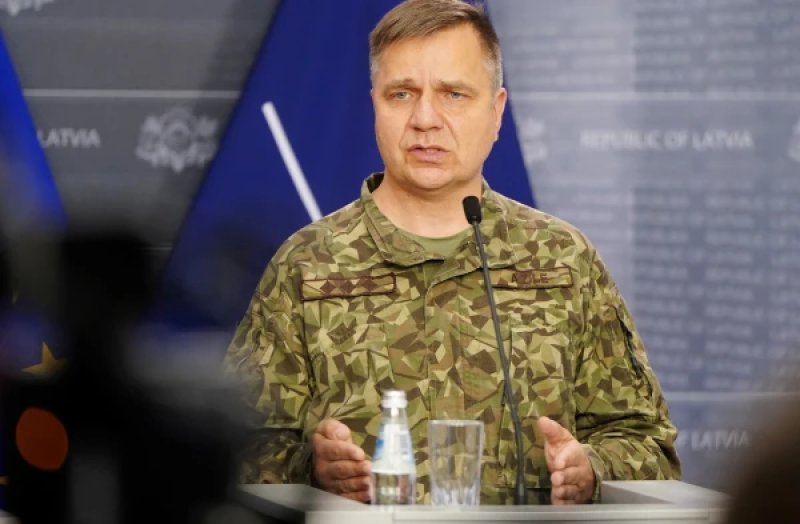
The responsibility for identifying people who are still without electricity and communication after the storm of the past weekend, as well as for providing them with the necessary assistance, lies primarily with the municipalities. This was stated on Monday after a government meeting on crisis management by the head of the Crisis Management Center (KVC) Arvis Zile. "First and foremost, in such cases, it is the responsibility of the municipalities, as they know their residents, understand how far they are from the center, and practically know each person individually," Zile noted. Currently, about **75,000 households** are still without electricity, reported Sandis Jansons, chairman of the board of the distribution system operator AS "Sadales tīkls." At the press conference, Zile mentioned the so-called **"72-hour bag"** several times. According to him, a more serious threat, such as military action, will not disappear after 72 hours. Therefore, residents must be psychologically prepared for the fact that the supplies for the first three days will only be a transitional phase before a much longer period of difficulties. > "In such conditions, during a more destructive disaster, restoring electricity supply within 72 hours may prove impossible," Zile stated. Therefore, he believes that households should think in advance about what will happen, for example, in winter, if electricity goes out. "A generator of the right capacity is necessary to ensure the operation of the most important systems — home heating, water supply, electric stove, so that, for example, a bottle can be warmed for an infant," explained the head of KVC. Zile acknowledged that previously, when residents were informed about the contents of the "72-hour bag," generators were not mentioned in the list of necessary items. However, they are now considered essential for survival, so households are advised to acquire such devices if possible. The cost of generators ranges from several hundred to several thousand euros. At the same time, about two-thirds of the residents of Latvia live in apartment buildings. Zile added that the Crisis Management Center will have to develop proposals for creating so-called **resilience points**. These could be special places in regions where residents can turn during a crisis to receive up-to-date information, access communication, and obtain other necessary services. The head of KVC also acknowledged that another problem emerged during the recent storm. Despite the issuance of red and yellow warnings through the mobile phone alert system about heavy rain and wind, these messages were not always taken into account in practice. In particular, events with large gatherings of people continued to be held. Therefore, KVC will prepare proposals for the government regarding specific actions after such warnings are announced. It will be necessary to determine what can continue to be done and what must be stopped when an orange or red level of danger is declared. It is also planned to develop an action algorithm that residents and event organizers should follow in such situations. Currently, as Zile admitted, the decision effectively remains the responsibility of the organizers themselves. Meanwhile, the head of the State Fire and Rescue Service (VUGD) Mārtiņš Baltmanis reminded that the Civil Protection and Disaster Management Act already allows municipalities to restrict gatherings and residents' movement for up to two weeks by their decision. "Regardless of whether the organizer wants to hold an event or not, any municipality can impose a ban on gatherings and movement in a specific area for up to two weeks in accordance with this law," explained the VUGD representative. Another problem identified during the storm was **the exchange of information between government structures**. According to Zile, data from various institutions allow for determining where electricity is available or absent, where fuel is accessible, which gas stations are operational, and which are not, as well as obtaining other necessary information. However, institutions were unable to effectively exchange this data among themselves. Therefore, KVC will prepare proposals on how to eliminate such shortcomings. The goal is to ensure that during crisis situations, all services can interact as efficiently as possible, and the population receives more complete information — for example, about communication disruptions in specific regions. As reported, on Saturday, August 22, and the following night, Latvia was hit by the strongest summer storm in decades. In some places, wind speeds exceeded 30 meters per second. The elements caused extensive damage to distribution and transmission power networks. Initially, electricity supply was disrupted for approximately **277,000 customers** across Latvia. Following the power outages, communication ceased in many areas, gas stations became inaccessible, and there were also problems with the operation of stores in some places. The recent storm showed that the usual preparedness to survive the first 72 hours of a crisis may not be sufficient. Authorities intend to review the alert and information exchange system, create special resilience points, and residents are advised to prepare for prolonged power outages — including acquiring home generators.
