

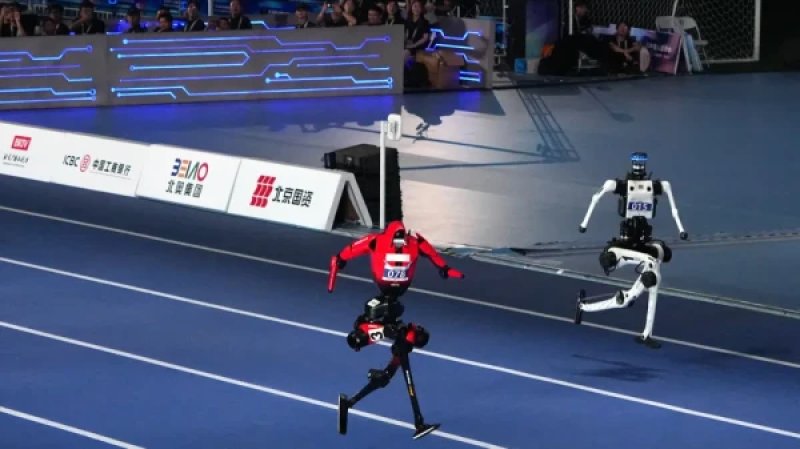
At the World Games of Humanoid Robots in Beijing, the Chinese robot Tiangong Ultra set an impressive time in the 100-meter race. The machine completed the distance in 9.39 seconds — 0.19 seconds faster than Usain Bolt's world record, which he set in 2009 with a time of 9.58 seconds. Tiangong Ultra, developed by the Beijing Innovation Center for Humanoid Robotics, finished first. The second place was taken by the Lightning robot from Honor, which recorded a time of 9.47 seconds. However, after the finish, it became clear that high speed is not the only challenge for robots. Tiangong Ultra was unable to stop in time and crashed into a special mat designed to halt its movement. The machine nearly veered into the audience. Lightning lost its balance and fell after crossing the finish line — it had to be carried off the track on a stretcher. Notably, Lightning had previously demonstrated even higher speed. During a training run, it covered 100 meters in 9.32 seconds, reaching a maximum speed of 14.5 meters per second. In April, this robot also won the Beijing Half Marathon among humanoid machines, completing the distance in 50 minutes and 26 seconds. Before the current competition, developers increased the length of its legs by 10 centimeters. In just one year, the performance of robots has significantly improved. At the first World Games of Humanoid Robots, Tiangong Ultra recorded a time of 21.50 seconds in the 100-meter dash — more than twice as slow as the current result. This year's competition features 2,056 robots from 666 teams across 16 countries. Participants compete in 51 disciplines, including running, football, dancing, and performing various manufacturing tasks. China views the development of humanoid robots as one of the strategic directions of its industry, making such competitions not only a sporting show but also a demonstration of the capabilities of a rapidly evolving sector.
