

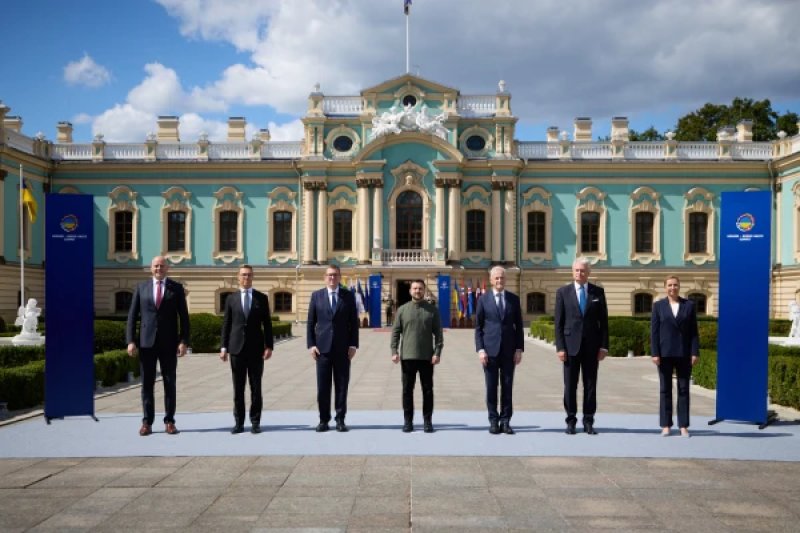
European leaders joined Ukrainian President Volodymyr Zelensky in Kyiv on Monday to celebrate the 35th Independence Day of Ukraine amid the ongoing full-scale Russian invasion that has persisted for nearly five years. On August 24, 1991, the Ukrainian parliament voted for the country's independence from Moscow. This decision was later overwhelmingly supported in a referendum. One of the goals of the full-scale invasion initiated by Vladimir Putin in February 2022 was to bring Ukraine under Moscow's control. As there have been no significant changes on the front line for several months, and more than a year of peace efforts led by the United States has yielded no obvious progress, both countries have become embroiled in an increasingly large exchange of airstrikes, resulting in civilian casualties and infrastructure destruction. UK Prime Minister Andy Burnham, making his first foreign trip since taking office last month, arrived in Kyiv on Monday. Along with him, nearly a dozen other European leaders and high-ranking officials, including European Council President António Costa, visited the Ukrainian capital. Burnham is co-chairing a meeting of the so-called “Coalition of the Willing” — a group of states helping Ukraine resist the Russian assault. Leaders from France and Germany are expected to join the meeting remotely. “For Ukraine, independence is not an abstract idea. We have defended it against all odds,” said Ukrainian Foreign Minister Andrii Sybiha on social media. “In such times, countries understand how important it is to have allies by their side,” he added. Speaking at St. Sophia Square in Kyiv, Zelensky stated that the presence of European leaders reflects Europe’s concern about Russia’s broader ambitions. “We all understand that in this Russian war against us — against Ukraine — much more is at stake than just the future of Ukraine and Eastern Europe,” Zelensky said, emphasizing the vital importance of foreign aid. “No country in such a war could rely solely on its own weapons,” he stated, adding that “no country could withstand such intense attacks without the help of the world.” The leaders who arrived in Kyiv promised to continue military and financial support for Ukraine. Burnham announced that the British government has agreed to allow defense company MBDA to disclose secret information about British components used in the long-range SCALP missile, his office reported. This could pave the way for France and Ukraine to implement plans to produce this weapon directly on Ukrainian territory. SCALP is the French version of the British Storm Shadow missile. Both systems use joint French-British technology. Kremlin spokesman Dmitry Peskov stated that the Kremlin views this plan “extremely negatively.” He accused the UK of “participating in this war” on Kyiv's side. In its confrontation with the Russian army, Ukraine largely depends on assistance from NATO countries, although relations with the US have cooled under President Donald Trump. Russia, in turn, receives assistance from North Korea and China. Over the years of war, Ukraine has rapidly developed innovative drone technologies that have allowed it to strike targets on Russian territory at distances of up to 2000 kilometers. The solemn speeches at St. Sophia Square were accompanied by a demonstration of weapons produced in Ukraine. Both Russia and Ukraine are using long-range strikes to create economic difficulties for the enemy, disrupt military supplies, and undermine the morale of the population. Amid the intensification of the air war, Ukraine's stock of US-made Patriot interceptors has been severely depleted. Kyiv urgently needs new interceptors before winter sets in, when Russia regularly strikes energy supply facilities. However, due to the war with Iran and slow production rates of complex interceptors, Ukraine has found itself vulnerable and is experiencing a shortage. Meanwhile, Ukraine continues to strike targets on Russian territory. After large-scale attacks against the largest Russian e-commerce company Wildberries in recent days, Ukraine has also targeted the second-largest Russian online retailer Ozon. Additionally, Ukraine continues to strike Russian defense industry enterprises and oil refineries. Thus, the celebration of the 35th anniversary of Ukraine's independence has simultaneously become a demonstration of European support for Kyiv and a reminder of the ongoing war. Against the backdrop of a shortage of air defense resources and intensified mutual long-range strikes, Ukraine is counting on further assistance from allies and the expansion of its own arms production.
