

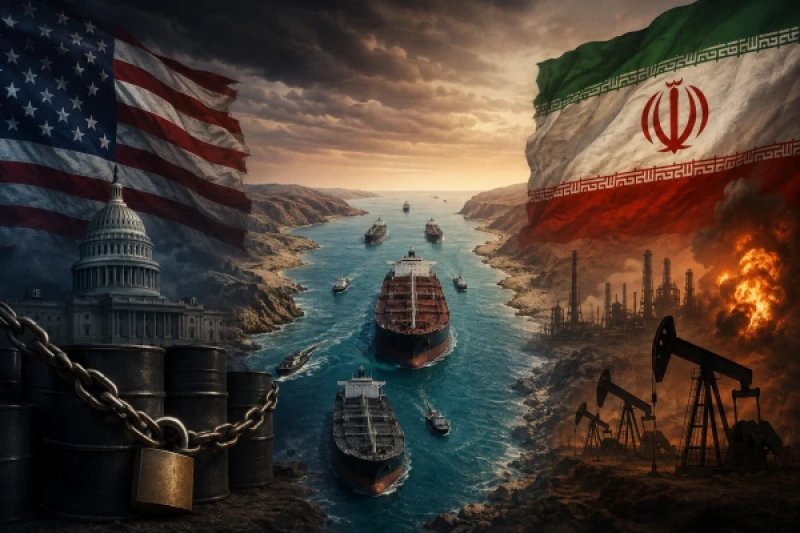
The United States is opening a new front in the war against Iran today. This is not about bombs and missiles, but about what U.S. Treasury Secretary Scott Bessent called "economic D-Day." Washington intends to completely isolate Iran from the global economy and threatens punishment to other countries and companies that continue to do business with Tehran, [reports](https://nos.nl/artikel/2628157-vs-komt-met-economische-d-day-tegen-iran-maar-teheran-heeft-tegenwapen-hormuz) NOS. Bessent speaks of "the largest financial attack ever launched against an adversary." At 8:00 PM Dutch time, he is expected to announce what specific measures the U.S. will take. However, it is already clear that Washington intends to strike not only directly at Iran but primarily at its trading partners. Countries that transport Iranian oil, facilitate financial transactions, accept Iranian aircraft, or register vessels that help Tehran circumvent sanctions, according to Bessent, will have to make a choice. Those who help Iran economically stay afloat risk finding themselves in economic isolation. Thus, China—Iran's largest oil buyer—could also be under threat. Beijing condemned the American threats and stated that sanctions cannot resolve the conflict. ### From Military to Economic Pressure The new strategy marks another phase in a conflict that has lasted nearly six months. After extensive American and Israeli airstrikes on Iran and subsequent Iranian retaliatory attacks, there have been no direct strikes between Iran and the U.S. for several weeks. However, a political resolution to the conflict is still not in sight. Washington believes that Iran is now vulnerable enough to be compelled to make concessions through economic tools. The Iranian economy was already suffering from high inflation, a weak rial, energy issues, and years of sanctions before the war. Now, it has added damaged infrastructure, reduced production, and enormous recovery costs. The goal of the new campaign is significantly broader than the previous American policy of "maximum pressure." Bessent stated that it is necessary to cut off "every economic artery" of Iran. In his opinion, complete financial isolation of the country could help avoid a new large-scale application of American military force. An Iranian analyst, who wished to remain anonymous, told NOS from Tehran that new sanctions and stricter enforcement could further intensify the pressure. According to him, this could lead to further weakening of the Iranian currency and undermine the trust of citizens and investors. "The greatest damage is inflicted by a maritime blockade. If it lasts for several more weeks or months without any easing, the consequences could indeed be devastating," the analyst noted in a comment to NOS. ### Hormuz as a Key Weapon However, Tehran has a powerful economic lever for counter-pressure—the Strait of Hormuz. A significant portion of the world's oil and gas exports passes through it. "If the economic war continues, not a drop of oil will be exported—neither through the Strait of Hormuz nor from any other point in the Persian Gulf," warned Mohsen Rezaei, Secretary of Iran's Supreme National Security Council. According to him, states that join the American campaign could be viewed by Iran as participants in the war. At the same time, in practice, Tehran does not have full control over the Strait of Hormuz, said Syed Ghoneim, chairman of the Institute for Global Security & Defense Affairs based in Abu Dhabi, to NOS. In recent weeks, more commercial vessels have been passing through the strait again. Many of them are navigating near the coast of Oman and under American escort. "The increase in shipping shows that Iran's ability to control maritime traffic and restrict it is diminishing," Ghoneim told NOS. However, the expert emphasized that this does not mean that Iran has lost the ability to disrupt shipping or significantly increase its costs. ### Who Will Set the Rules? According to Ghoneim, the next phase of the confrontation may be less about the opening of the Strait of Hormuz and more about the rules by which it will operate. Key questions arise about who will determine shipping routes, who will guarantee their safety, and who will have the right to participate in regulating shipping. Oman plays a special role here. Muscat is trying to negotiate with Iran on conditions that would allow for the continuation of shipping. In this way, Tehran may attempt to secure a permanent role in managing the situation around the Strait of Hormuz. Washington, on the other hand, seeks to prevent the emergence of an Iran-Oman agreement that would leave the U.S. sidelined. As a result, Washington's economic attack could lead to unforeseen consequences. The more the U.S. pressures Iran and countries that continue to cooperate with Tehran, the more reasons the Iranian leadership will have to keep the Strait of Hormuz as a tool of pressure. Thus, the "economic D-Day" announced by Washington becomes a serious gamble. The U.S. is trying to strip Iran of its last economic maneuvering opportunities and force it to make concessions without a new large-scale military operation. Tehran, in turn, makes it clear that it is capable of retaliating against one of the most sensitive points in the global economy—the route upon which global oil and gas supplies directly depend.
