

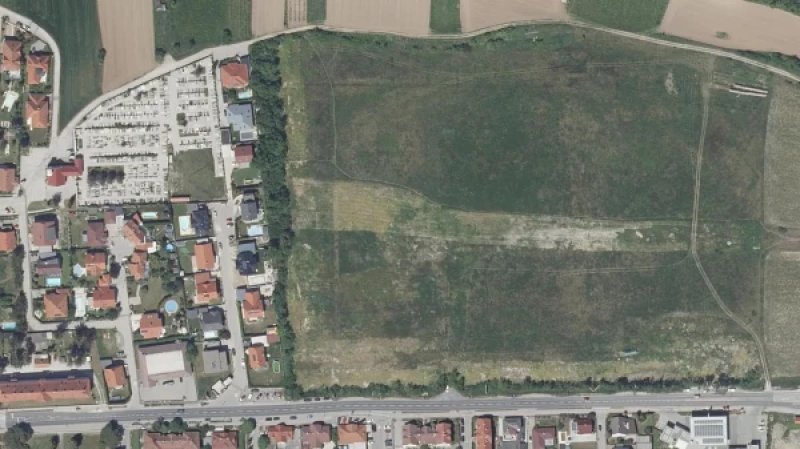
Today, the only reminders of the grim past of the area near Leobersdorf, Austria, are a few partially destroyed concrete structures. Once, this was the site of a large forced labor complex known as Weinberglager. Now, a business park with commercial and warehouse facilities, including a cold storage facility, is being built on this land, Euronews reports. The project, presented in 2024, has sparked a heated debate in Austria. Opponents of the construction believe it is unacceptable to turn a site associated with the crimes of the Nazi regime into commercial territory. "For me, this is sad because a place burdened by history is being developed, sacrificed for the economy," said Erich Strobl, who heads a local initiative to preserve part of the area. ### Hundreds of Women Were Held Here After the annexation of Austria by Nazi Germany in 1938, the Weinberglager complex was used to house thousands of prisoners of war and people sent for forced labor. Later, a branch of the Mauthausen concentration camp was established in Hirtenberg — one of the largest camps in Austria that exclusively housed women. From September 1944 to April 1945, around 400 women, mostly from the Soviet Union, as well as from Italy and Poland, were held here. They were forced to produce infantry ammunition at a nearby facility. After the war, the barracks and most other camp structures were gradually demolished, rebuilt, or destroyed. However, historian Bertrand Perz, an expert on Mauthausen's history, believes that the Hirtenberg area remains historically significant, particularly because the fate of the female prisoners long remained on the periphery of the memory culture surrounding Mauthausen. ### "Grief, Anger, Rage" Archaeological studies have revealed remnants of the camp complex. However, the Federal Monuments Office of Austria decided that the findings were insufficient to grant the area monument status. Now, bulldozers are working on the site, and the first structures are being erected. The International Mauthausen Committee has opposed the development of the former concentration camp site. Board member of the "Mauthausen Committee Austria" Josef Pumberger expressed his feelings in three words: "grief, anger, rage." According to him, it is especially hard to see such things happening in Austria in 2026. Additional disputes arise over the history of the land ownership. Previously, the land belonged to a company linked to local mayor Andreas Ramharter. According to local media, it was sold for more than 15 million euros in 2022 and 2023. The new owner, TRA LEO GmbH & Co KG, told AFP that they are willing to support the creation of a memorial. ### Austria Long Avoided Discussing the Past In the first post-war decades, Austria primarily presented itself as a victim of the Nazi regime, leaving the involvement of many Austrians in the crimes of the Third Reich in the shadows. The country only began to discuss its responsibility for the Holocaust more openly from the late 1980s. According to historian Perz, a public discussion around Hirtenberg would have been nearly impossible several decades ago. Today, society is much more attentive to the preservation of such sites. At the same time, there is also an opposing trend — the desire to "finally put this behind us" and stop returning to the past. In 2024, a memorial stele was erected in Leobersdorf in memory of the victims of the Hirtenberg camp. ### Memory or Commerce The debate surrounding Hirtenberg has gone far beyond a typical construction project. Essentially, it concerns whether it is permissible to develop sites associated with Nazi crimes when most of the historical structures have already been lost. The developer proposes to support the creation of a memorial. Activists, however, believe that commercial development gradually erases the material memory of the people who were held captive and forced to work here.
