

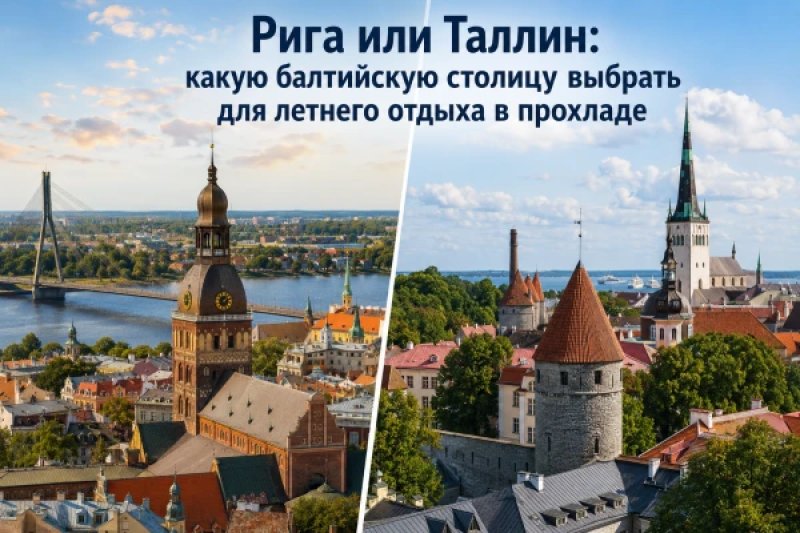
The popular tourist route includes the three capitals of the Baltic states — Vilnius in Lithuania, Riga in Latvia, and Tallinn in Estonia — but each of these capitals is charming in its own way for a separate long weekend. Considering that Vilnius is located about 300 kilometers from the coast, while Tallinn is situated on the shore of the Gulf of Finland and Riga on the shore of the Gulf of Riga, I believe it is more appropriate to compare the two coastal cities, writes a Euronews correspondent. Having visited both in the summer of 2025, I would say that Tallinn seemed more "touristy," possibly partly because its UNESCO-listed Old Town is smaller, making the crowds feel denser. Both cities are incredibly walkable, but in Tallinn, I found myself using public transport more often than in Riga. Estonia, in general, is known for its widespread adoption of digital technologies and a large number of tech companies, and overall, Tallinn struck me as a slightly more modern city compared to Riga. In terms of language and culture, Estonia is closer to Finland: the Uralic language is spoken here, while Baltic languages are spoken in Latvia and Lithuania. Despite this, there are more similarities than differences between the cities, and I am sure you will find plenty of reasons to fall in love with each of them — more details below. ## ## Riga, Latvia Riga is a treasure for architecture enthusiasts: the city center features a variety of styles, from medieval to modern. The "Three Brothers" complex houses the oldest residential buildings of medieval Riga: one dates back to the 15th century, while the second and third are from the 17th century. Today, these three buildings host the Latvian Museum of Architecture, where you can learn more about the country's most famous architects. Let’s move to the 19th — early 20th century: about a third of the buildings in the center of Riga are built in the Art Nouveau style. There are different directions of this style, including the national romantic style, unique to the country, which can be seen in the Quiet Center area. On Alberta iela street, you will also find the Museum of Art Nouveau, which provides insight into how these apartments originally looked inside. Returning to the 21st century, a true landmark is the National Library of Latvia. To truly appreciate the details embedded in the design by the famous Latvian architect Gunārs Birkerts, you can either book a guided tour in English or visit the library's website for a self-guided tour. The city’s skyline is adorned with numerous church spires; the tallest is St. Peter's Church, where you can climb the tower to enjoy the best panoramic view of Riga. The rooster has become one of the symbols of the city and adorns many churches, including St. Peter's, where the rooster figure has been present since 1491 (though the current version was installed in 2009). As you might guess, the image of the early bird is used in many souvenirs sold throughout the city, but a traditional treat is also the sugar rooster, which can be purchased as well. Speaking of food: Riga's Central Market, one of the largest in Europe, offers fresh vegetables, fruits, meat, fish, and much more in five pavilions, each of which once served as a hangar for a military airship. I also really enjoyed the Āgenskalns market — a historic building from 1898 that found new life in 2022 after a four-year restoration. On the first floor, vendors sell dairy products, vegetables, fruits, and other treats, while the second floor features a food court with local dishes. Craft brewing is actively developing in Latvia: there is one craft brewery for every 25,000 residents. In Riga, the best places to try it are the establishments Nurme and Labietis. The Riga agglomeration stretches to the shores of the Gulf of Riga, but the part of the city where you are most likely to spend most of your time is located inland, along the banks of the Daugava River, so don’t expect beaches. Instead of the usual red tourist buses found in almost every tourist city, you can opt for a cruise along the Riga Canal and the Daugava. ## ## Tallinn, Estonia Like Riga, Tallinn's Old Town, which originated in the 13th century, is listed as a UNESCO World Heritage site. And, like Riga, Tallinn was one of the most important cities of the Hanseatic League. You can learn about this history at various sites — at Toompea Castle (where free guided tours are conducted from Monday to Friday by prior arrangement), at the Kiek in de Kök museum of fortifications, and at the Great Guild Hall, which now houses the Estonian History Museum. For a dose of city history and a beautiful view at the same time, head to Tallinn Town Hall: it has a 64-meter tower that you can climb for an additional fee. Another option is the two viewing platforms at the top of Toompea Hill, Kohtuotsa and Patkuli. It’s best to come here early in the morning or late in the evening: when cruise ships arrive with day tourists, it gets really crowded. Be sure to check out the Kalamaja district, which is located on the shore of the Gulf of Finland. Its main attraction is the Estonian Maritime Museum, but if you move further away from the Old Town, you will discover many restaurants, cafes, bars, and shops. My trip to Tallinn coincided with the Song and Dance Festival, which takes place every five years, but the festival grounds are open for visits year-round. Estonians have always loved singing, but over time these festivals turned into a form of protest: they performed national songs instead of slogans approved by the Soviet authorities, which ultimately led to the "Singing Revolution," through which all three Baltic states regained independence. This page of history is best studied at the Vabamu Museum — the Museum of Occupations and Freedom, which tells about the Nazi and Soviet occupations, as well as at the former KGB prison, which is open to visitors. As mentioned earlier, a popular route is to combine the capitals of the Baltic states into one big trip, but from Tallinn, you are only a two-hour ferry ride away from Helsinki.
