

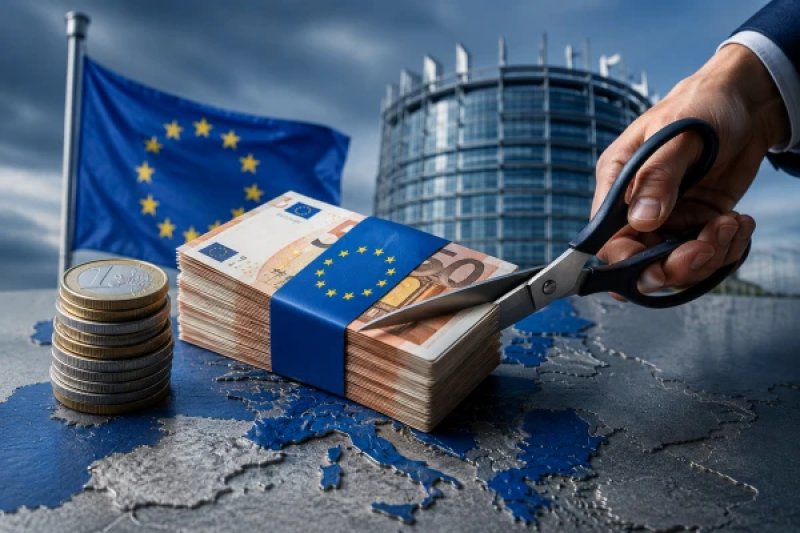
Denmark, Germany, the Netherlands, Austria, Finland, and Sweden have advocated for a significant reduction in the draft of the next seven-year budget of the European Union, reports the Danish agency Ritzau. The European Commission proposed a budget for 2028–2034 amounting to nearly **€2 trillion**. However, the six countries consider this amount excessive and demand a reduction in spending by several hundred billion euros. This is not about cutting any single program. The countries insist on finding savings opportunities across almost all areas of EU expenditure. ## Areas they do not want to cut Despite the demand to significantly reduce the overall budget, the six countries highlight areas they consider priorities. Danish Prime Minister Mette Frederiksen stated that these include primarily **defense and security, support for Ukraine, and protection of the EU's external borders**. Thus, if the total budget is indeed significantly reduced, the EU will have to look for opportunities to cut other expenditures. This could make the upcoming negotiations particularly challenging: EU countries will need to agree not only on the size of the overall budget but also on which areas will receive less funding. ## Negotiations aimed to be completed by 2026 Denmark, Germany, the Netherlands, Austria, Finland, and Sweden also advocate for the long-term budget negotiations to be completed **by 2026**. This implies a rather tight schedule for agreeing on one of the most contentious issues within the EU. The EU's long-term budget determines the allocation of European funds for seven years ahead. It finances, among other things, agriculture, regional development, infrastructure, scientific research, foreign policy, and other pan-European programs. Therefore, the demand to cut the budget by several hundred billion euros inevitably raises the question of which specific expenditure items may be subject to cuts. ## Research funding may be at risk One area that may suffer from budget savings is European science. The European Commission initially proposed to increase funding for research programs. However, the demand from several countries to significantly reduce the overall EU budget may change these plans. Senior advisor at the Danish think tank Tænketanken Europa Jan Høst Schmidt believes that Germany's position, which advocates for budget discipline, plays a particularly important role. In his assessment, with truly large-scale cuts in expenditures, it is hard to imagine that funding for scientific research will remain completely untouched. An additional factor is the desire to conclude budget negotiations before the presidential elections in France. ## The fight for funding is just beginning The European Commission's proposal does not yet mean that this budget will ultimately be adopted. The EU's long-term financial plan traditionally becomes the subject of complex negotiations among member states. Some countries are interested in maintaining significant funding for agriculture, others focus on regional development, while others demand more funds for defense, security, innovation, or enhancing the competitiveness of the European economy. Now, this is compounded by the demand from six countries to cut the overall budget by several hundred billion euros. At the same time, the proponents of savings make it clear that the new geopolitical realities require maintaining significant expenditures on security, defense, Ukraine, and the EU's external borders. As a result, pressure may increase on other areas of the European budget. For Latvia, the outcome of these negotiations is particularly important: the country is a recipient of significant funds from European funds, so a large-scale reduction in the overall EU budget could potentially affect regional development, infrastructure, agriculture, science, and other areas.
