

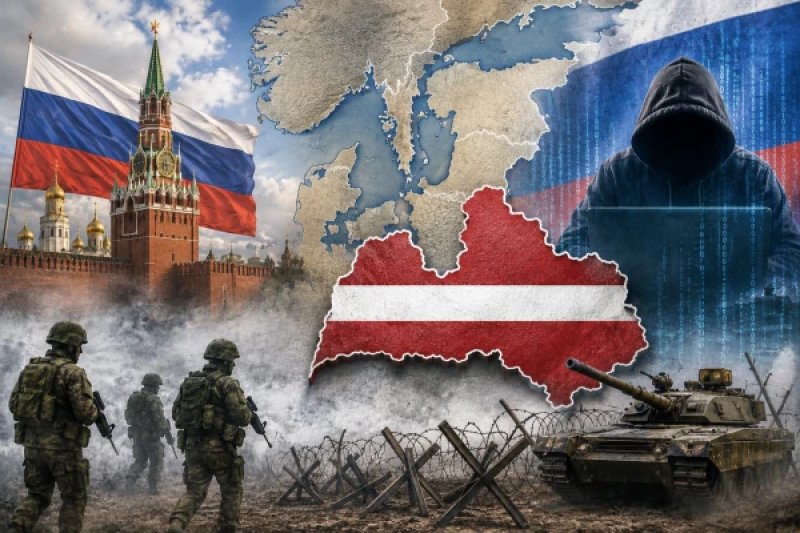
Currently, Russia does not pose a direct military threat to Latvia, although a number of signs indicate potential long-term plans, acknowledged the Satversme Protection Bureau (SAB). According to SAB, under Vladimir Putin's regime, a distorted perception of threats continues to prevail, driven by the increasing closedness of the Kremlin elite and the lack of critical opinions within it. Russia's attitude towards Western countries, including Latvia, is becoming increasingly sharpened and aggressive. SAB, in collaboration with other intelligence and security services of the EU and NATO, is monitoring the situation and events in the region. SAB's observations indicate that Russia's perception of Latvia is becoming increasingly similar to how it perceived Ukraine before the war began. This could contribute to more aggressive actions by Russia over a longer period of time, thereby significantly increasing security risks for Europe. Currently, Russia does not pose a direct military threat to Latvia, although a number of signs indicate potential long-term plans. At the same time, Russia's information activity, including its rhetoric, has become more sharpened and provocative, notes SAB, citing as examples the unfounded accusations made in May 2026 regarding Latvia's involvement in Ukrainian drone attacks on Russia, as well as the dissemination of false and distorted information related to language proficiency checks. According to SAB, the intensified information activity of Russia, which is likely also influenced by economic and other internal problems in Russia, is an attempt to exert pressure on both Latvia and its allies to reduce support for Ukraine. As reported, the commander of the National Armed Forces (NAF) also acknowledged that there are currently no direct military threats to Latvia; however, the NAF is considering the possibility of hybrid provocations from Russia. He noted that there is no increased presence of armed forces from aggressor states at Latvia's borders. In the winter of 2021, Russian troops remained at the borders of Ukraine after military exercises, which was followed by a full-scale invasion. Currently, there are no circumstances that would allow a similar scenario to repeat in the Baltic region. At the same time, the NAF is considering the possibility of hybrid provocations from Russia. Furthermore, due to ongoing hostilities in Ukraine, the re-entry of foreign drones into Latvian airspace cannot be ruled out. The NAF is taking specific actions to mitigate the risks of hybrid threats, the NAF commander noted. Enhanced support is already being provided to the State Border Guard to deter organizers of illegal migration from continuing their activities, as well as to identify and detain individuals illegally crossing the border. It was also reported that the Director of the U.S. Central Intelligence Agency (CIA), John Ratcliffe, during his visit to Moscow, warned Russian officials against escalating the conflict with NATO, especially with Estonia, Latvia, and Lithuania, two informed sources told the online publication Politico on Wednesday. "The main goal of Ratcliffe's visit was to warn against escalatory actions against the Baltic states," one of the sources stated. The second source added that the CIA director also attempted to persuade Moscow to reduce military and economic support for Iran. Earlier, The Wall Street Journal also reported on Wednesday that Ratcliffe warned Russia against attacking NATO member states. According to Latvian President Edgars Rinkēvičs, the level of military threat and its assessment have not changed, and the risk of direct Russian invasion is currently low. At the same time, the president noted that various diversions, cyberattacks, and hybrid operations remain possible. In fact, Latvia and other NATO and European Union countries face them regularly. Both the internal affairs system and the National Armed Forces, along with NATO allies, are taking measures to prevent such actions, he noted. Thus, there is currently no immediate military threat to Latvia, and there are no signs of a scenario similar to that which preceded Russia's invasion of Ukraine at Latvia's borders. At the same time, SAB draws attention to long-term risks: Moscow's attitude towards Latvia is becoming more aggressive, and its perception of the country increasingly resembles its attitude towards Ukraine before the war began.
