

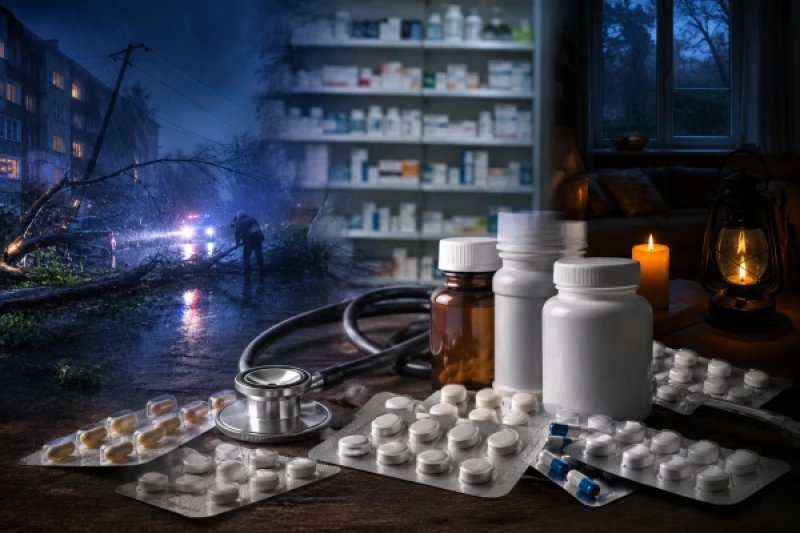
Latvia needs a unified national-level crisis plan for ensuring the supply of medications, stated Signe Jantone, executive director of the Latvian Association of Pharmaceutical Manufacturers. She noted that the recent storm was a test of the ability to ensure the continuity of medical care and the supply of medications, and Latvian pharmaceutical manufacturers continued to operate even amid power outages. Jantone emphasizes that this experience raises a broader question about the readiness of the Latvian healthcare system and the medication supply chain for large-scale crises in general, as well as whether the government has done enough to ensure clear coordination, information exchange, and action plans for various scenarios during a crisis. According to her, Latvian pharmaceutical manufacturers had to practically implement pre-prepared crisis plans to continue production and ensure proper storage of both raw materials and finished products. The systems created by companies, technical solutions, and the readiness of employees allowed for the continuity of operations. Other participants in the medication supply chain also acted promptly. They did everything possible to quickly restore the operations of affected pharmacies, ensure the supply of medications, and provide suitable conditions for storing medicines. Some pharmacies were temporarily unable to operate due to power and communication outages. The storm tested the industry's ability to mobilize and simultaneously highlighted which problems companies can solve on their own in a crisis situation and where more active government involvement is necessary, Jantone emphasized. She points out that the safety and availability of medications do not end at the doors of the factory or pharmacy. A patient gains little benefit from a medication being produced and delivered to a pharmacy if they cannot obtain it during a crisis. This can happen, for example, if e-health or other government information systems are down and no alternative procedures for dispensing medications are in place. Additionally, many medications need to be stored at specific temperatures at home. If the necessary conditions cannot be ensured, the quality and effectiveness of the medications may be compromised, posing a risk to the patient's health. Jantone notes that the Ministry of Health, in collaboration with the industry and other involved institutions, needs to develop a clear action plan. This plan should define not only the operations of hospitals and emergency medical services during a crisis but also the tasks of family doctors, pharmacies, laboratories, manufacturers, and suppliers of medications. She also mentions that Latvia imports about **95% of medications** and is largely dependent on international supplies of medicines and foreign manufacturers. Latvia does not have state reserves of medications for outpatient patients. There is also no clear state-level mechanism that would allow for the continuous supply and dispensing of medications to patients in the event of prolonged power outages, communication failures, or information system disruptions. In practice, the resilience of the system largely relies on the readiness of companies — the minimal stockpiles of medications created by supplying companies, alternative supply solutions, backup infrastructure, and the ability to respond quickly. The initiative of individual companies cannot be the sole basis for the long-term security of the state healthcare system, Jantone emphasizes. She states that Latvia needs a unified national-level crisis plan for the supply and dispensing of medications. This plan must provide for a clear procedure for information exchange between government institutions and the industry, the offline dispensing of medications, and the prior identification of pharmacies and family doctor practices whose operations need to be prioritized during a crisis. In these locations, priority should be given to restoring power and communication or ensuring alternative solutions, while also considering additional safety measures if necessary. At the same time, Jantone notes that it is necessary to create state reserves of critically important medications for outpatient patients. The procedure for maintaining and updating these reserves under normal conditions, as well as the principles for their distribution and delivery during a crisis, should be defined. The state’s capacity for medication production is crucial for the system's resilience. Strengthening local manufacturers is not protectionism or sentimental patriotism, but a pragmatic policy for national security. Jantone reports that local production has a specific role in this system. If international supplies are disrupted, the capacities of Latvian manufacturers can be utilized for state needs faster than obtaining medications from distant foreign factories, whose deliveries may take several weeks. Therefore, even before a crisis, it should be clearly known which medications and in what volumes Latvia is capable of producing, what raw materials need to be stockpiled, and how quickly these production capacities can be activated if necessary. "Crisis preparedness cannot be built when the crisis has already begun. Unfortunately, crisis after crisis shows that the government does not learn enough from previous mistakes, and they are repeated. The recent storm confirmed that Latvian pharmaceutical manufacturers supplying companies and pharmacies are capable of responding and maintaining the continuity of the medication supply and pharmaceutical care even under significant but generally short-term infrastructure disruptions. However, a unified state system for medication safety that would allow for effective and coordinated action during prolonged crises has still not been created. It is time to use the industry’s experience, its readiness, and the lessons of the recent crisis to create such a system," Jantone stated. She points out that the industry has been calling for years, within the framework of dialogue and cooperation, to develop and implement a clear, practically feasible model for ensuring the availability of medications under any circumstances, but so far, the matter has not progressed beyond statements from the ministry's leadership about their readiness to act and corresponding promises. Jantone expressed hope that the pre-election noise will soon subside and the new government will make the availability and safety of medications one of its priorities. As previously reported, on Saturday, August 22, and the following night, Latvia experienced the strongest summer storm in decades, during which wind speeds exceeded 30 meters per second in some areas. The storm caused extensive damage to both distribution and transmission power networks, initially disrupting power supply for approximately 277,000 customers in Latvia, and following the damage to power networks, communication, gas stations, and in some places, stores became unavailable. The Latvian Association of Pharmaceutical Manufacturers unites the leading manufacturers of medications and therapeutic agents in the country, which ensure the production of high value-added products. The pharmaceutical industry withstood the recent storm: manufacturers, suppliers, and pharmacies were able to maintain operations or restore them quickly enough. However, as the association warns, in the event of a prolonged crisis, relying solely on the readiness of individual companies is not feasible. Therefore, even before the next emergency situation, the government is urged to determine where and how medications will be dispensed without functioning electronic systems, which medications need to be kept in reserve, and what role Latvian manufacturers should take in emergency supplies.
