

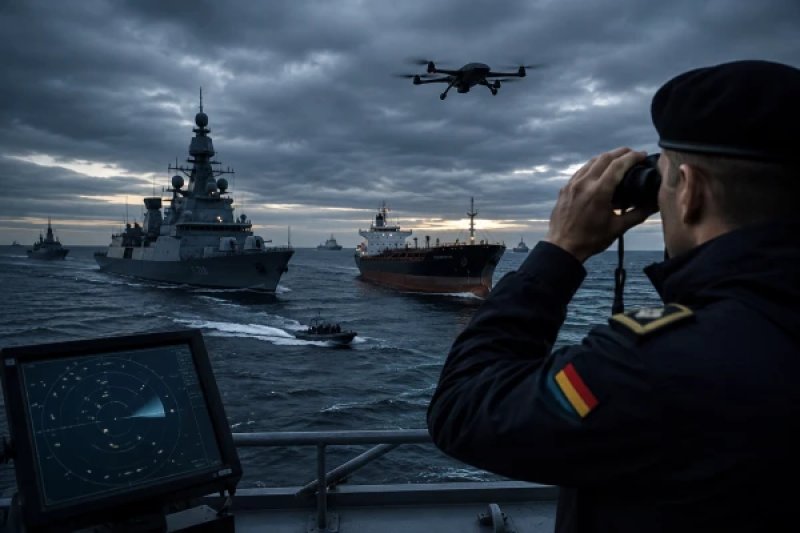
The Russian Navy "is acting aggressively, monitoring bases and units, trying to intimidate and carry out sabotage by flying drones and using a 'shadow fleet' in the Baltic Sea," said Kaak. The inspector of the German Navy reported that Russia is now also protecting the vessels of its 'shadow fleet' by using military ships or armed security groups on board. However, Kaak noted that this creates an additional burden on the Russian fleet, whose resources are not unlimited. The 'shadow fleet' includes tankers and cargo ships that Russia uses to circumvent sanctions, such as the price caps on Russian oil exports to third countries imposed by Western nations. The vessels often sail under foreign flags and conceal their route or the origin of their cargo. Kaak acknowledged that Germany and its allies now have a much clearer picture of maritime activity thanks to the integration of data from ships, aircraft, coastal radars, and satellites. Whereas it previously took 17 hours to detect suspicious activity, this can now be done in one hour, added the inspector of the German Navy. He also emphasized the importance of naval forces in protecting global trade, stating that events in the Middle East, the Red Sea, and the Persian Gulf show that freedom of navigation cannot be taken for granted. The vice admiral added that the personnel strength of the German Navy is increasing for the first time, with an expected increase of 3,000 personnel by 2026. Kaak also reported changes in the deployment of two German ships that were sent for a possible mine-clearing mission in the Strait of Hormuz and are now in the Mediterranean Sea. The mine sweeper "Fulda" will initially remain there with a new crew, while the support vessel "Mosel" will return home and will be replaced if necessary. At the same time, NATO's surveillance capabilities regarding the situation in the Baltic have significantly increased. According to Kaak, whereas it previously took about 17 hours to detect suspicious activity, this can now be accomplished in approximately one hour thanks to the integration of data from ships, aircraft, coastal radars, and satellites.
